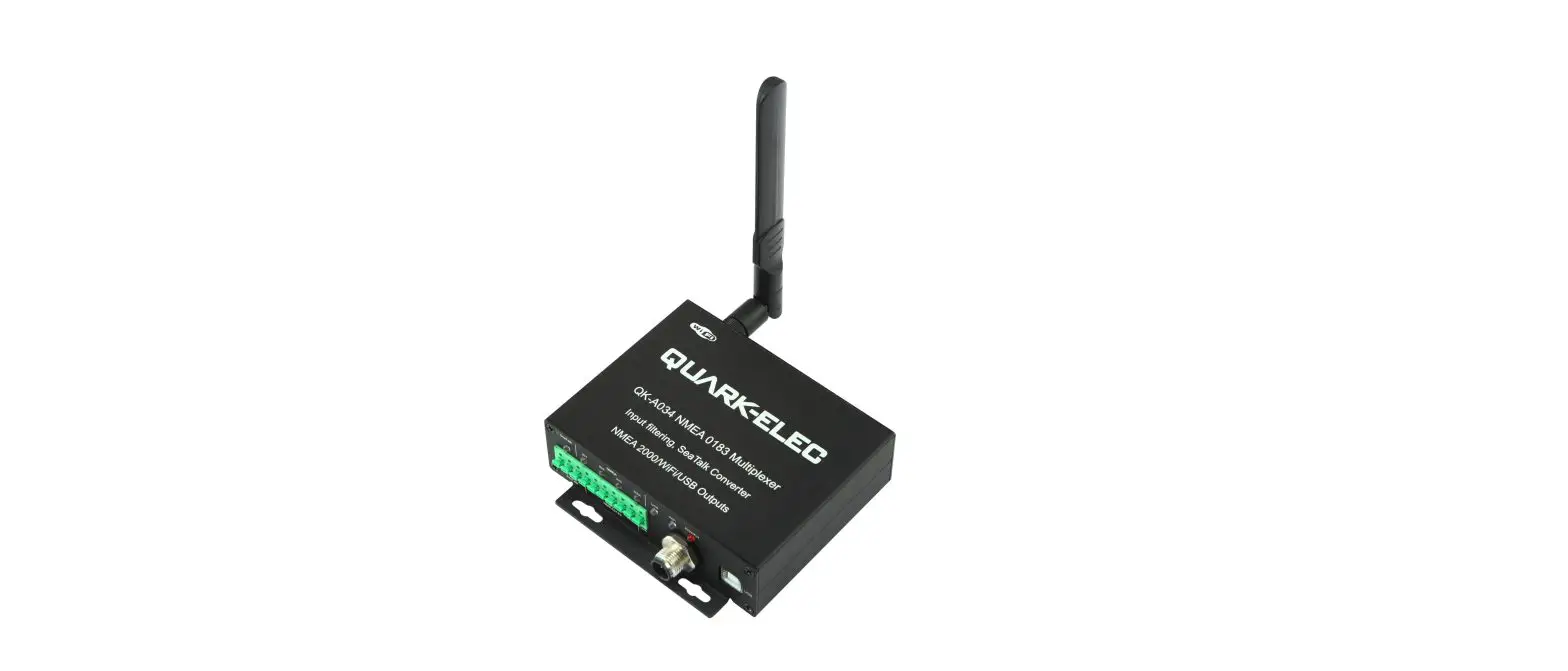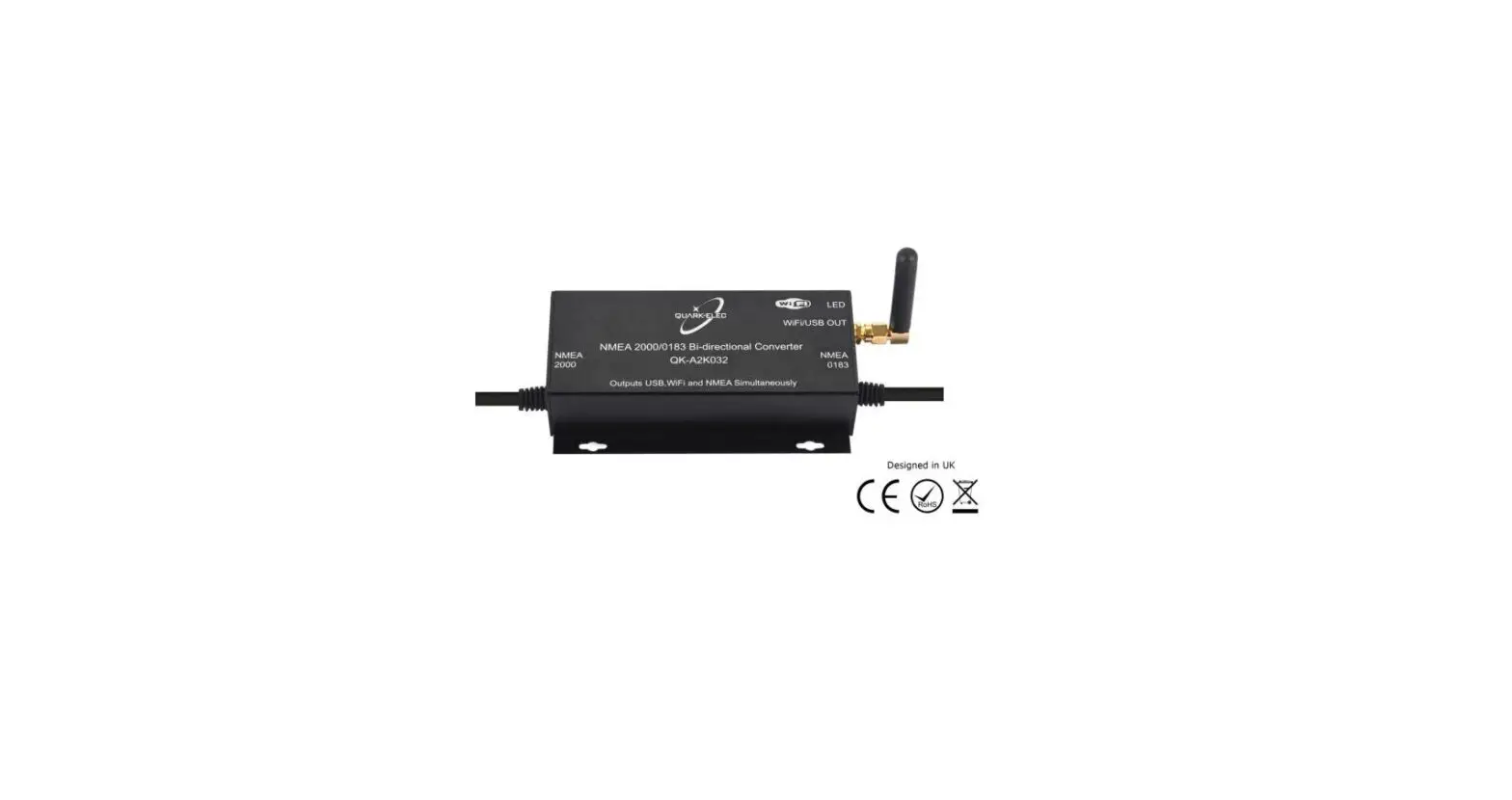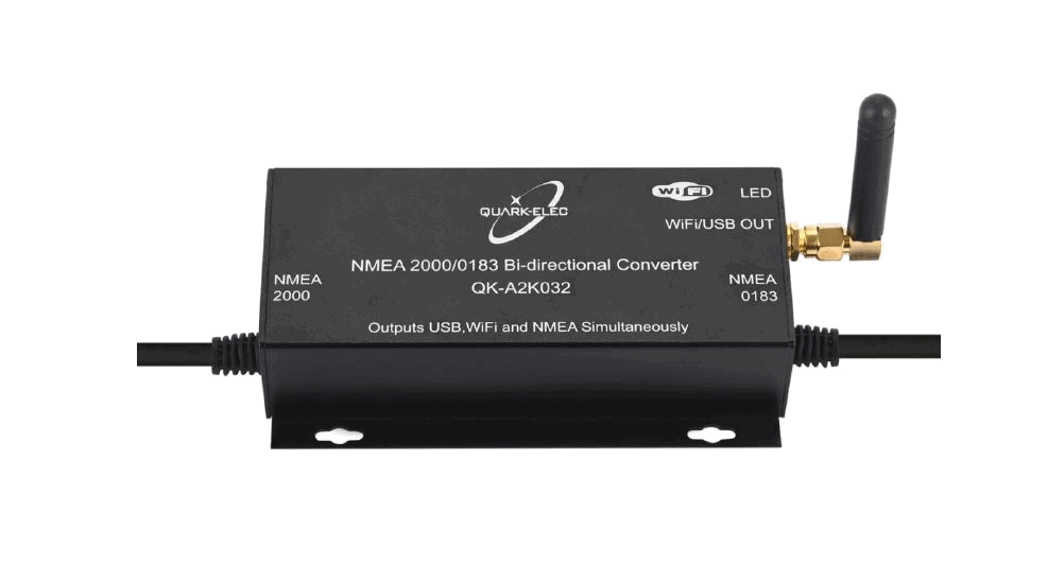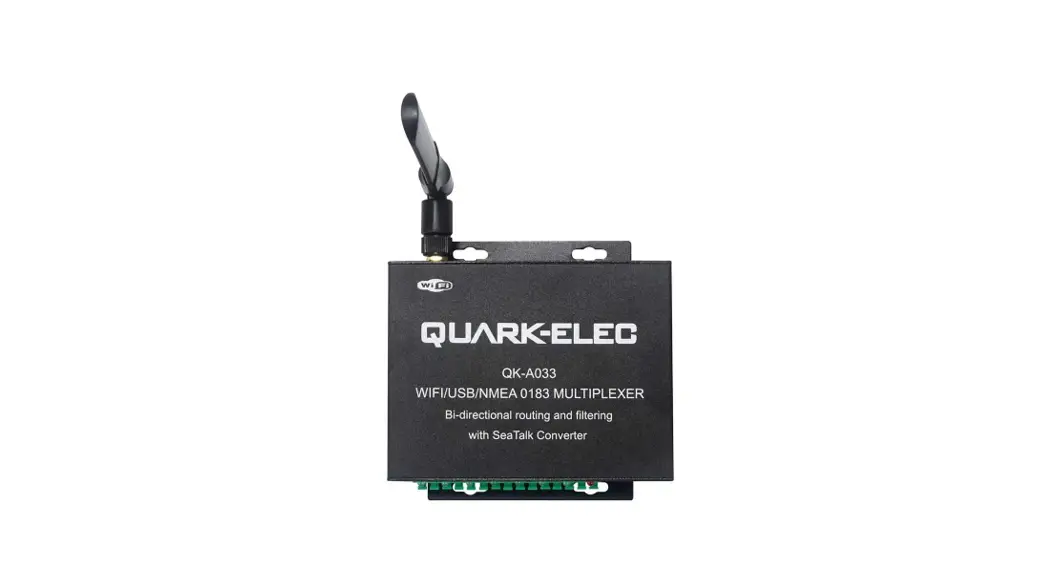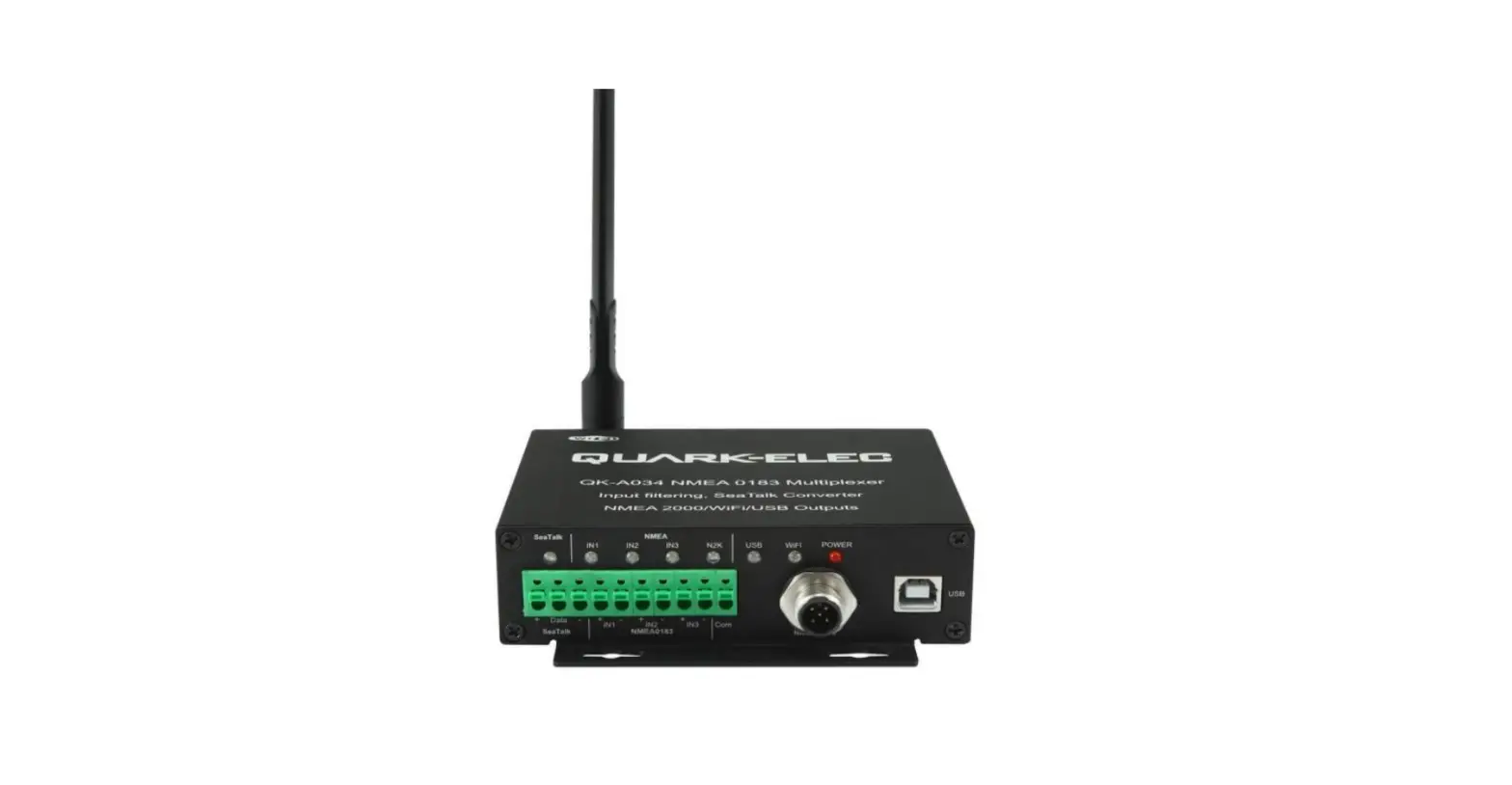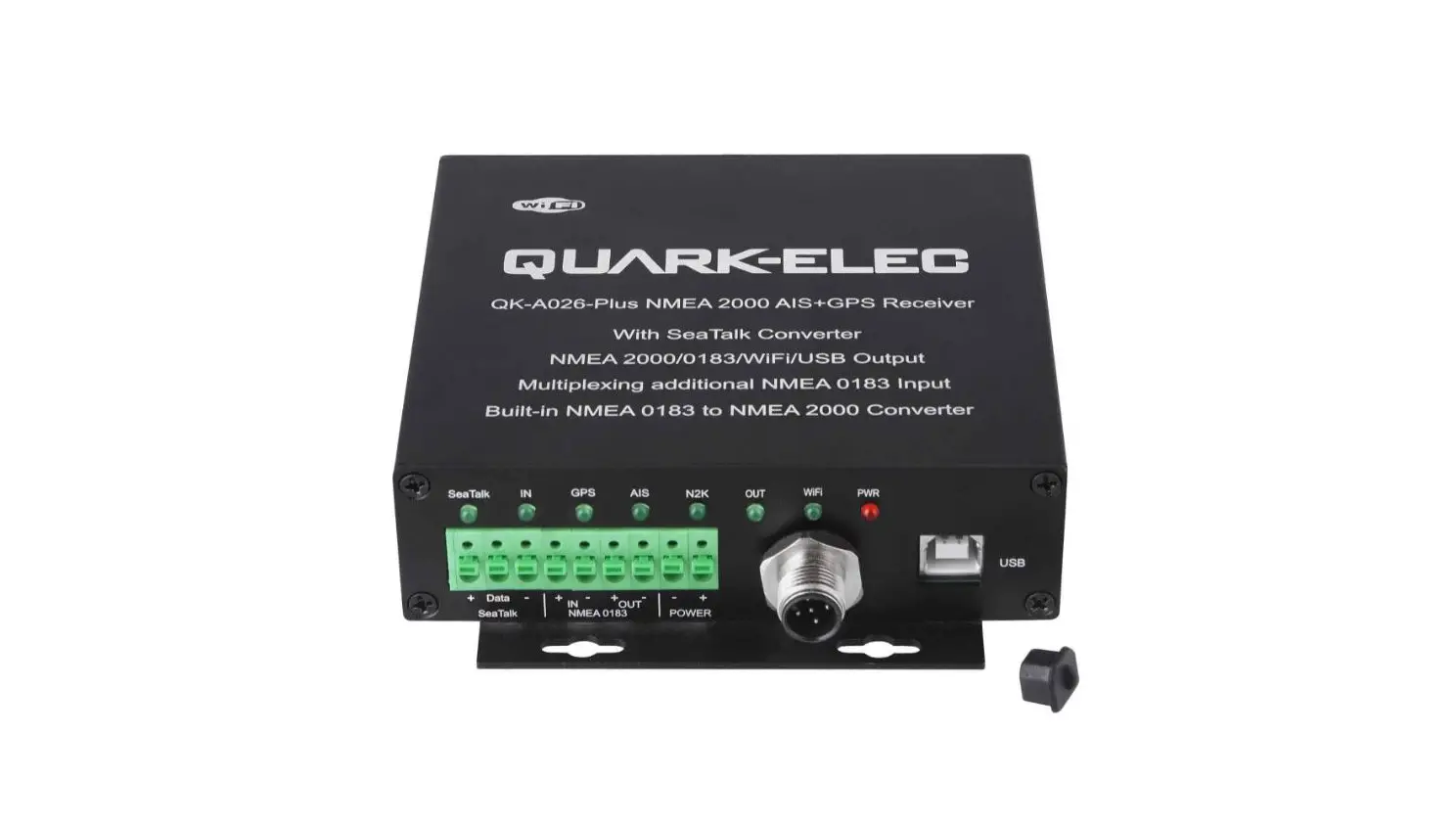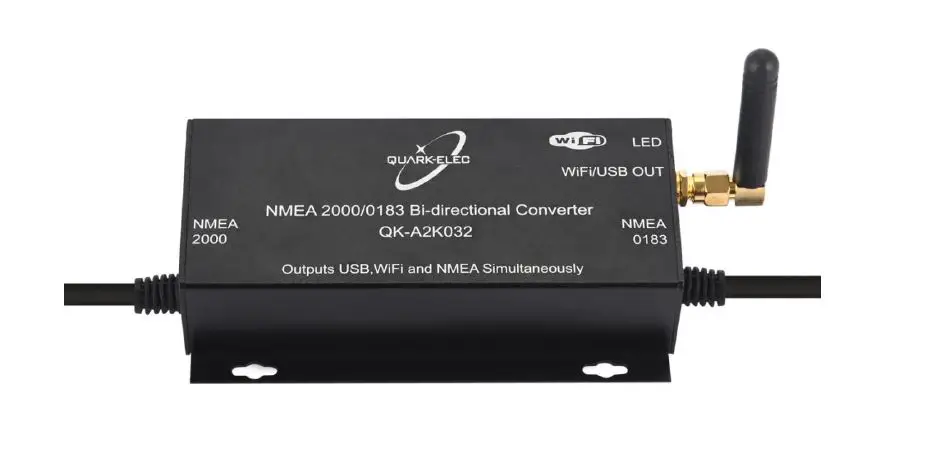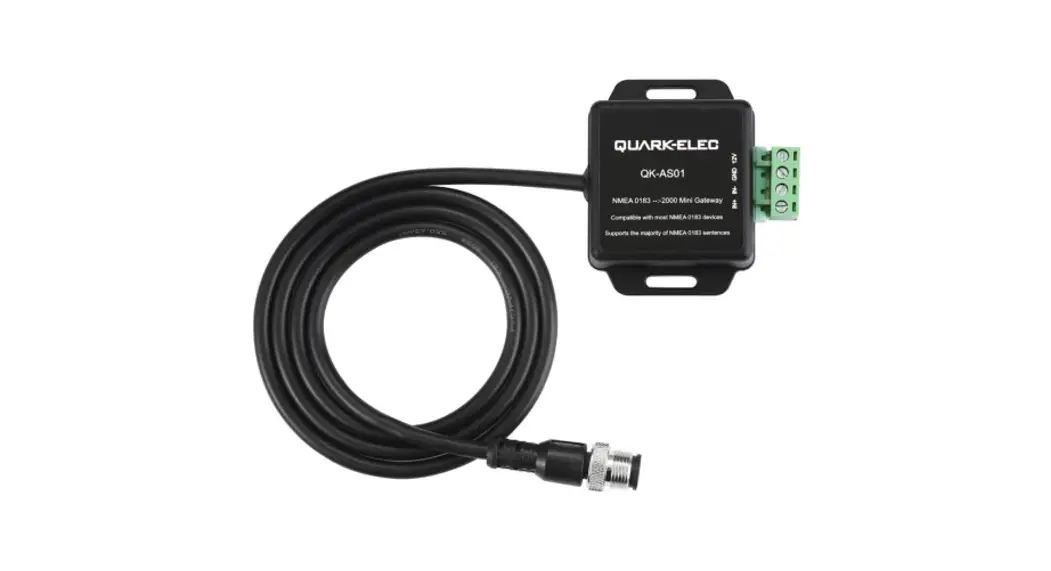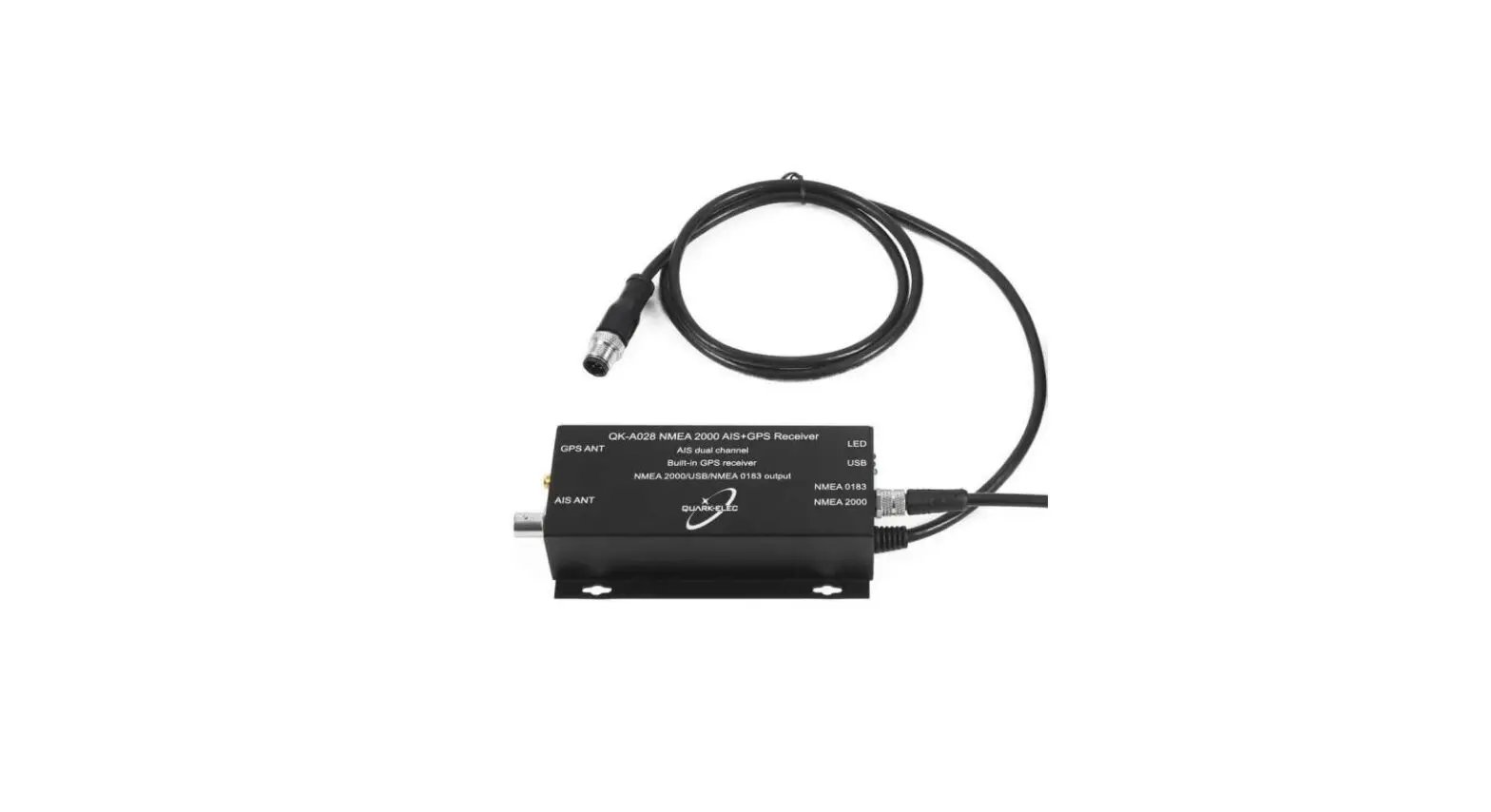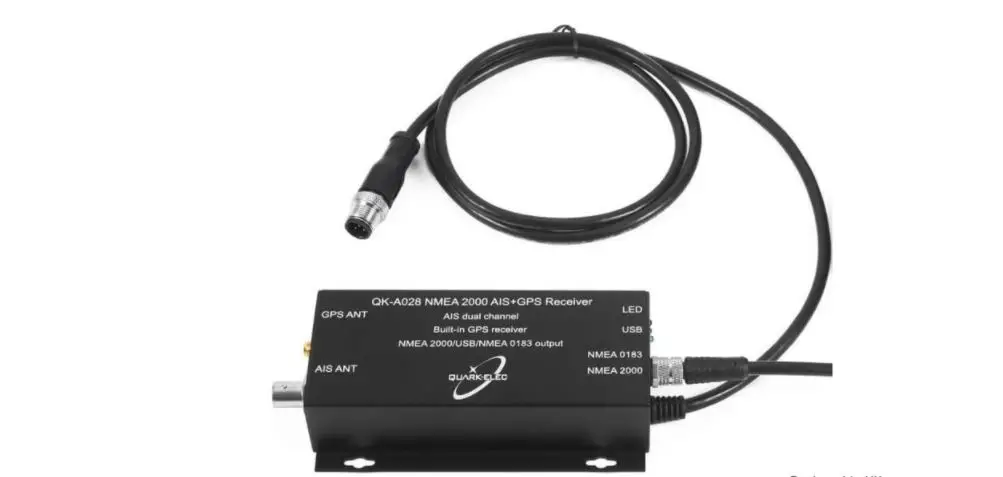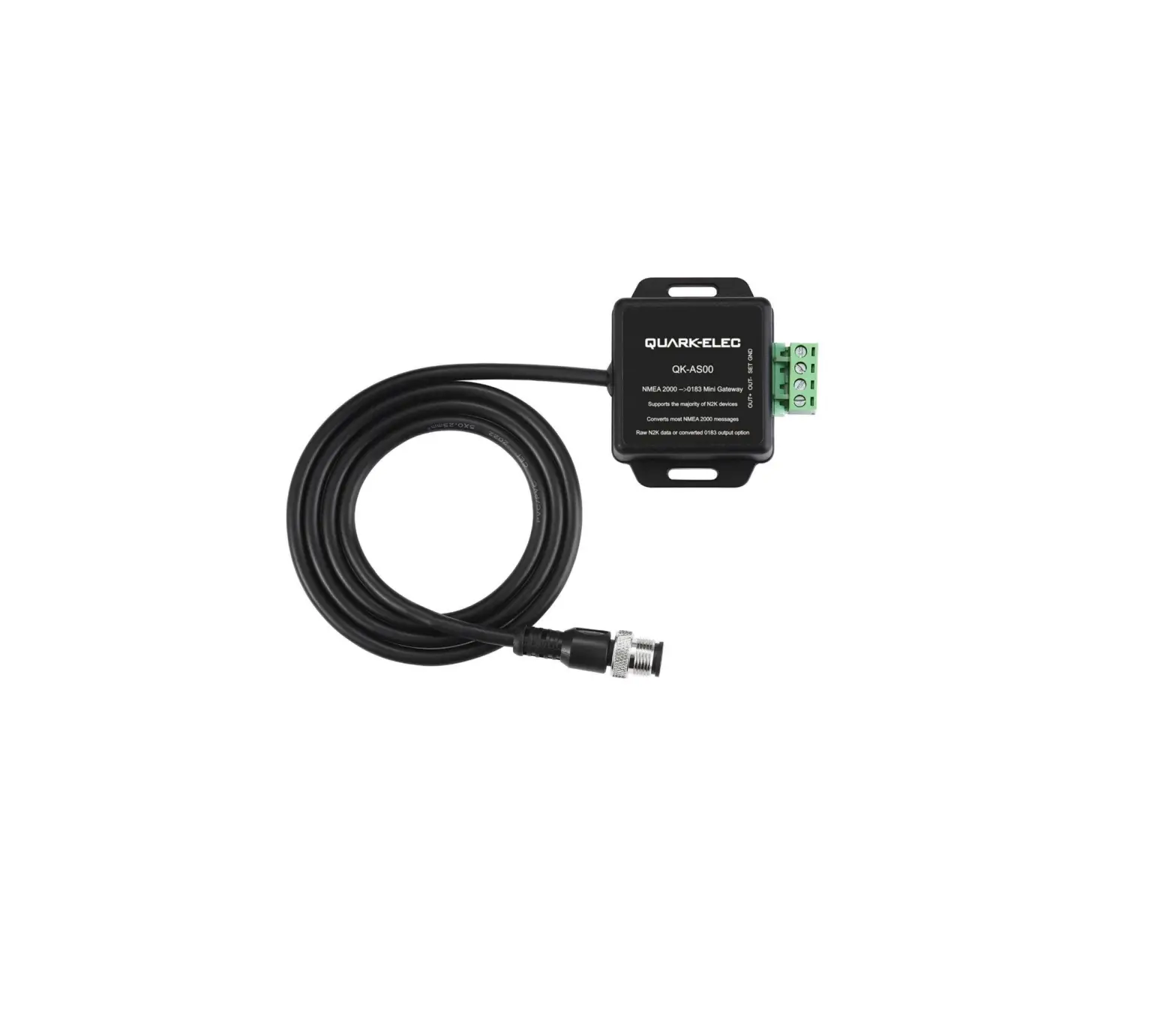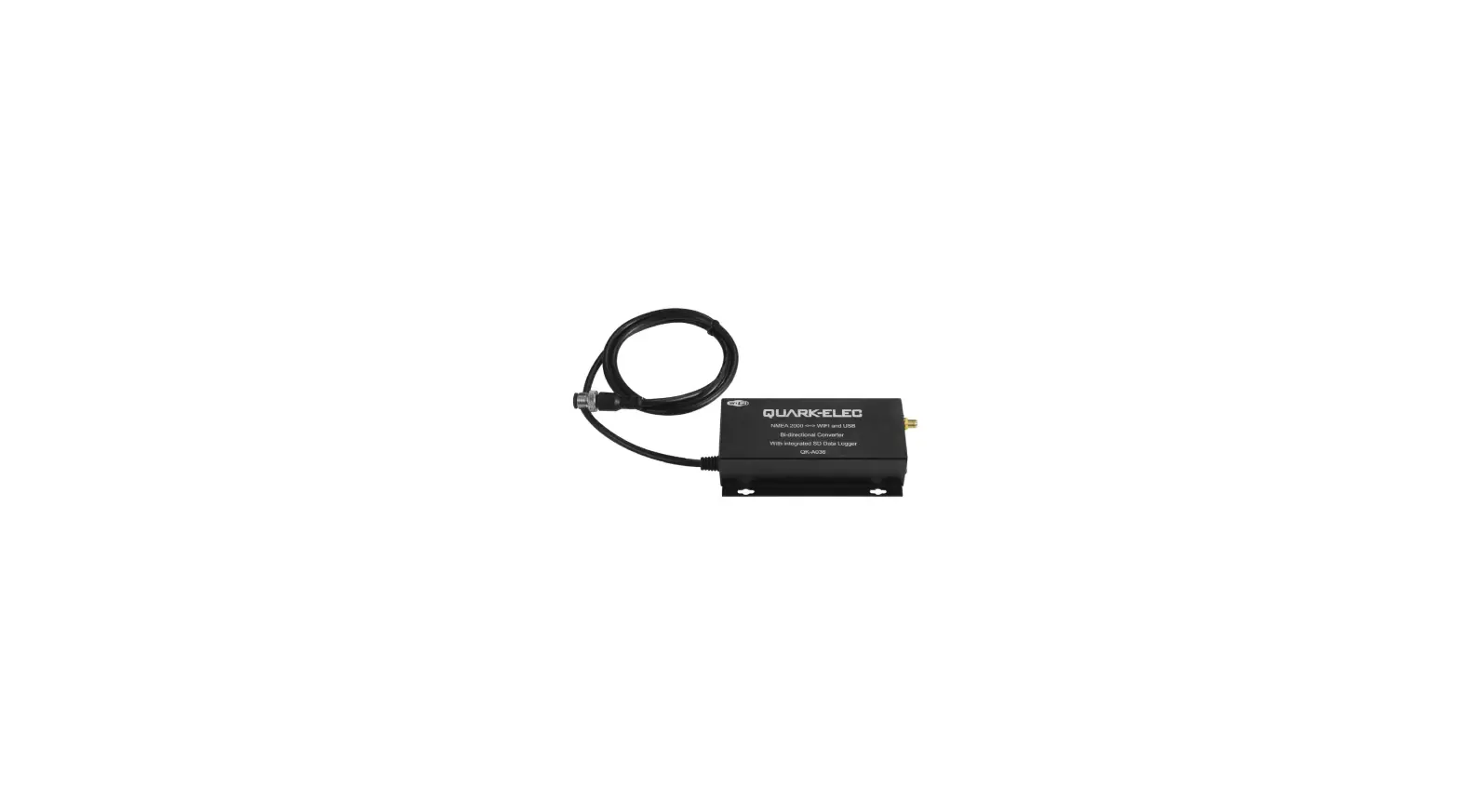

QUARK-ELEC QK-A036 NMEA 2000 WiFi /USB Bi-directional Converter With Integrated Voyage Data Logger
Features
- NMEA 2000 to WiFi and USB gateway
- Integrated SD card(32GB) for voyage data logging
- Converts the most common NMEA 2000 PGNs to / from NMEA 0183 sentences over WiFi and USB
- Records all NMEA 2000 network activity for system diagnosis and performance analysis
- Circular buffer preserves latest recorded data while oldest data overwritten when SD card is full
- Galvanic opto-isolation on NMEA 2000 CAN bus connection
- Free Firmware updates provided when new features and conversions are added. (Update via USB from Windows PC)
- Pre-fitted cables for ease of installation
- Recorded data in selectable format: NMEA 0183 or PCDIN(NMEA 2000 raw data)
- Read to access ‘Quark-cloud’
- WiFi supports Ad-hoc, station and standby mode
Setup Overview
Before leaving home
- Drivers and Configuration software are optional and only needed for specific features. The Configuration Software and specific instructions are included on the FREE CD and as a download from https://www.quark-elec.com/downloads/.
Consider if there is a CD reader/internet access on site, if you will use the features below.
Accessing data on a Mac/Linux/Windows PC
- Driver required if using Windows and should install automatically, if not, it is included on the free CD and at Quark-elec.com. Drivers are not required for Mac or
- 0V power from N2K bus
Connecting wirelessly to the A036 through Station mode WiFi (through a router, not just peer-to- peer directly from the device)
- Configuration software (Windows PC Required). Driver may be required as above
- 0V power from N2K bus
Access Quark-cloud. Operator can control the settings of communication with the Quark-cloud.
- Configuration software (Windows PC Required). Driver may be required as above
- 0V power from N2K bus
Installation and Setup
Mounting: Consider the location…
- Dry, sturdy location 0.5m from other WiFi/VHF equipment.
- Ensure there is the correct length of wires needed. If drilling holes for cabling, seal around any holes to prevent damage to the vessel or equipment. Keep the USB and SD card dust cover on if USB is not
Connect to the NMEA 2000 backbone (12.0V power)
The A036 draws 12.0V power from the NMEA 2000 backbone. Users will need an N2K backbone and 2 termination resistors (1 on each end).
Check LED lights are working on the A036
- Power: Top LED (red) flashes at 3 second
- NMEA 2000: Middle LED flashes for each valid NMEA 2000 PGNs sent out on NMEA 2000
- WiFi: Bottom LED flashes for each valid message activated on WiFi and USB
Need to connect wirelessly without a router?
- On personal device (phone, laptop etc.): 15 seconds after the A036 has powered up, users can scan for a WiFi network with an SSID similar to ‘QK-A036xxxx’. Connect the device to ‘QK- A036xxxx’ with the default password: ‘88888888’.
- In Chart software: set the protocol as ‘TCP’, IP address as ‘168.1.100’ and the port number as ‘2000’ in the chart software.
To connect wirelessly through a router (Station mode). A036 is set to connect wirelessly in Ad- hoc mode by default (‘peer-to-peer’ without a router or access point). You can change to Station mode (connecting through a router) using the Configuration software
Introduction
The A036 is a sophisticated NMEA 2000 to/from WiFi and USB multiplexer and an integrated vessel data recorder (VDR).
The A036 transfers data from an NMEA 2000 backbone to any compatible device (e.g. laptop, tablet or smart phone) connected to it via WiFi or USB port. With it, the N2K network data includes vessel course, speed, position, wind speed/direction, water depth and AIS messages can be viewed in the chart plotter software. The WiFi and USB connections are bi-directional so the chart plotter software can also send cross track and waypoint information to an NMEA 2000 autopilot to steer a programmed course.
In addition to bi-directional NMEA 2000 to WiFi and USB, the A036 is capable of recording the messages transmitted from every device interconnected on the NMEA 2000 network. All messages are stored with an integrated SD card. The stored data can be uploaded to Quark-cloud or accessed via an SD card reader (not provided). With an SD card with 32GB (expandable) of storage space the A036 can store up to an average of 7 weeks’ worth of vessel data. User won’t have to worry about losing the most recent data since A036 uses a circular buffer where the oldest data is overwritten only when memory is full.
Similar to most Quark-elec products the A036 can be used straight out of the box for standard functionality or configured for additional sophistication.
Default Standard Functionality: The multiplexer converts all messages on N2K backbone and sends this data to USB output and WiFi interface.
- Bi-directional WiFi: With 2-way WiFi connectivity, the A036 allows for wireless connection to autopilots and other NMEA devices if desired. Data from instruments is available wirelessly though WiFi connections, giving complete freedom to navigate, monitor and control from anywhere on board. Up to 4 connections from iPads, iPhone, Android phones and tablets or other WiFi enabled devices can connect directly to the A036 with no need for a WiFi access point. (Thought it can also be connected to an access point/router if desired (see WiFi section)
- Bi-directional USB: The USB port also supports bi-directional communications. It allows computer-based, navigation applications to send sentences through the multiplexer to control an autopilot and other devices. The USB port is also used for configuration of specific WiFi and NMEA ports settings.
- Records all NMEA 2000 Network activity for Vessel tracking and performance analysis (an SD card will need to be fitted).
Additional Configurable Functionality (through Windows software via USB):
- Additional WiFi options including connection to an access point to share marine data across your entire WiFi network and/or to connect the A036 to the Internet. Additionally, the WiFi can be disabled if desired.
- Upload the vessel data to Quark-cloud options: the recorded NMEA data (in .txt format) will be automatically uploaded to the cloud once the device has been registered and connected to the Internet. The Upload function can be disabled if desired. One device can have up to 8GB cloud space and the server will overwrite the oldest files once the space is full.
Mounting
The A036 is aimed at the commercial, leisure, fishing boat and vessel monitoring markets.
It is not waterproof so need to be mounted in a dry place such as behind the instrument panel on a flat surface. Please allow 0.5m between the A036 and other WiFi devices. This will help avoid interference problems.
If the USB is not being used then please use the USB dust cover provided. This will help maintain the port and keep dust out of A036.
The SD card dust cover should be applied all times even no SD card used.
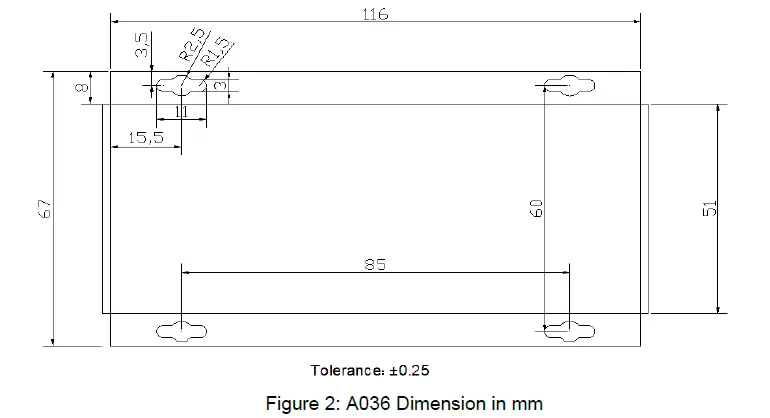
Connections
WARNING:
Disconnect all power sources before connecting your equipment!
Connecting to the NMEA 2000 network
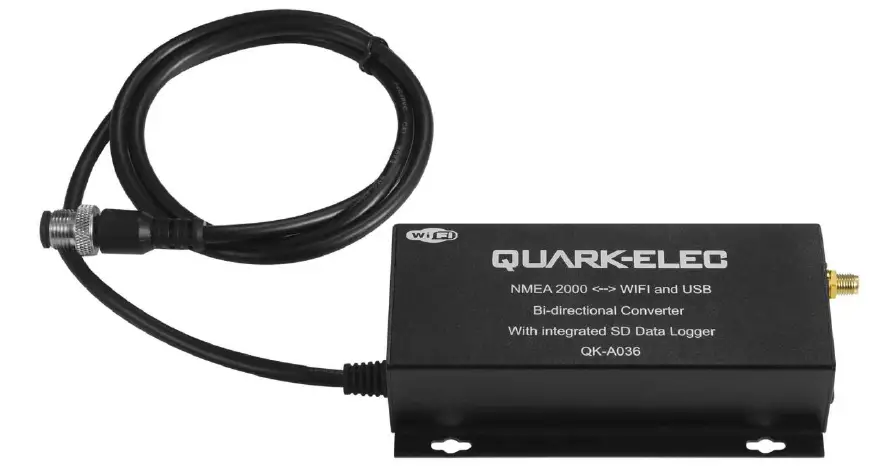
The A036 is pre-fitted with a five-core screened cable for the NMEA 2000 connection, fitted with a male micro-fit connector. Simply connect the cable to the network backbone using a T-piece connector.
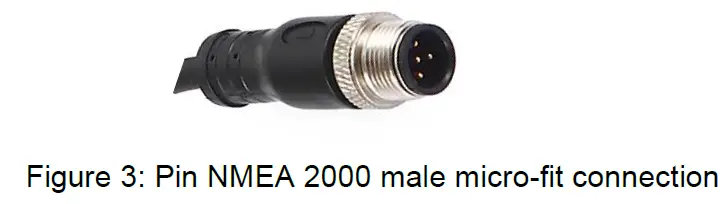 The main communication channel of a NMEA 2000 network is a NMEA 2000 backbone to which NMEA 2000 devices connect. Each NMEA 2000 device connects to the backbone with a T- piece connector. A NMEA 2000 backbone must be connected to power the A036. An NMEA backbone always required two termination resistors, one at each end.
Please note 12.0V power for the A036 unit comes from the NMEA 2000 backbone.
Micro SD card slot
A standard Micro SD card is pre-fitted in the A036 and is ready to use out of the box. If the operator has their own SD card they wish to use with the A036, please turn off the power before inserting it in the slot. The A036 will automatically format the card the first time powering up. The A036 will then restart itself after the formatting process has completed. After this process is complete the card can finally be used to save log files. The formatting process could take up to 3 minutes depending on the card storage size and speed.
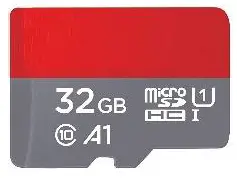 If the operator wants to delete all the recorded data, or for any other reason they want to format the card, simply run the configuration tool, ensure the configuration tool is connected to the A036 and then press CTRL+SHIFT+F9, a new window will pop up to allow formatting.
Wireless Connections
The A036 allows users to view the output data through WiFi on a PC, tablet, smartphone or other WiFi enabled device. Users can access marine network data including vessel course, speed, position, wind speed, direction, water depth, AIS etc. These can be viewed via the chosen chart software.
The IEEE 802.11b/g/n wireless standard has three basic modes of operation; Ad-hoc mode (peer to peer), Station mode (also called infrastructure mode) and Standby(WiFi disabled).
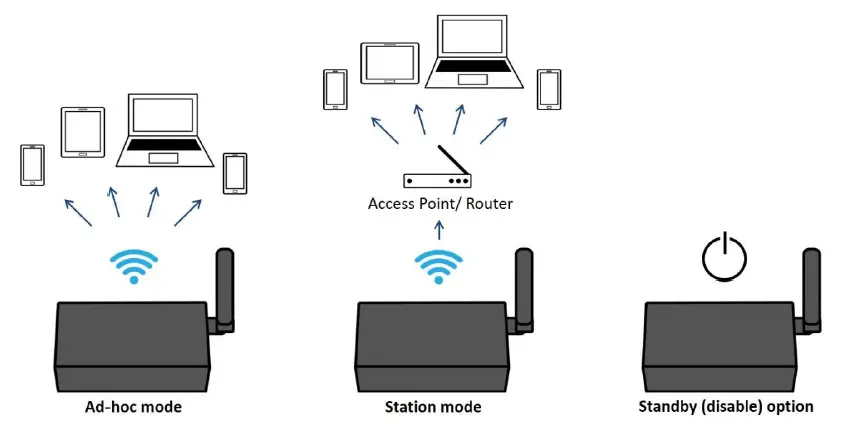 The A036 supports both:
- In Ad-hoc mode WiFi: mobile devices connect directly (peer to peer) to another device, without a router or access point. For example; PC, tablet or smartphone can connect directly to the A036 to receiver marine data.
- In Station mode WiFi: wireless devices communicate through an access point (AP) such as a router that serves as a bridge to other networks (such as the Internet or LAN). This allows the router to handle the data and traffic from the device. This data can then be picked up through the router anywhere on the local area network. This is similar to plugging the device directly into the router by wire, but instead using wireless technology. In this way, the mobile devices receive both the marine data and other AP connections for example Internet. A036 need to be setup with station mode if Quark-cloud service required.
- WiFi can also be disabled in Standby mode. This reduces power consumption and may be required when connecting 2 WiFi transmitting devices.
The A036 is set to Ad-hoc mode as a default setting, but can be easily setup to station mode through the configuration tool software.
WiFi Ad-hoc mode
From a phone, tablet or PC: Once the A036 has powered up, scan for a WiFi network with an SSID of ‘QK-A036’ or similar.
 In the chart software (or chart plotter), Set the protocol as ‘TCP’, IP address as ‘192.168.1.100’ and the port number as ‘2000’ in the chart software.
| Protocol | TCP |
| IP address | 192.168.1.100 |
| Data Port | 2000 |
With the above settings, a wireless connection should be established and the user will be able to receive the data through the chart software.
Note: In Ad-hoc mode, the IP address should not be changed.
SSID and password can be changed using the configuration software; the password should be between 8 to 12 characters.
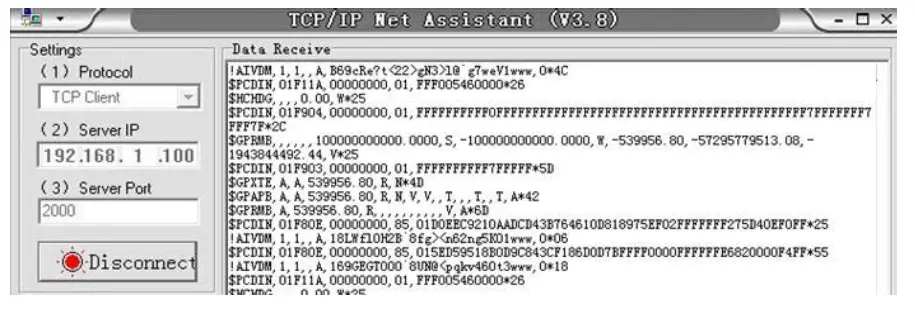
The wireless connection and data flow can be checked with TCP/IP port monitoring software as shown. (Image: TCP/IP Net Assistant shown as example)
WiFi Station mode
Station mode WiFi allows the router to handle the data and traffic from the device. This data can then be picked up through the router anywhere on the local area network. Similar to plugging the device directly into the router by wire, but instead using wireless technology.
This allows the main mobile device to still receive Internet and for users to be able to view the data. Users who use the Quark-cloud service must setup their A036 in station mode and get Internet access.
To begin using station mode the A036 should be attached to a computer running windows (for Mac user’s windows boot camp) via USB.
- Connect the A036 to the computer via Micro USB connection.
- Run the Configuration tool and check the connection to A036 at the bottom of configuration tool.
- Change the working mode field to ‘Station mode’
- Enter the router’s SSID.
- Enter the password for the network (The A036 allows the password should be 8 to 12 characters length).
- Enter the IP address to assign to the A036. Start with 192.168. The third group of digits depends on the router’s configuration (Commonly 1 or 0). The fourth group must be a unique number between 0 and 255. This number must not be used by any other equipment connected to the router.
- Enter the router’s IP address in the Gateway section. This can usually be found under the router. Leave the other settings as they are.
- Click ‘Config’ in the bottom right and wait about 60 seconds. After around 60 seconds click ‘Disconnect’.
- Reboot the A036. The A036 will now attempt to connect to the router.
- In the chart software set the protocol as ‘TCP’ Insert the IP address that was assigned to the A036 by the router. Enter the Port number as ‘2000’ in the chart software.
| Protocol | TCP |
| IP address | (check the router) |
| Data Port | 2000 |
Users should now be connected and see marine data on chart software.
If not, check the router’s IP address list and check the IP address that the router has given the A036. Occasionally, a router assigns a different IP address to a device than the one chosen. If this is the case, copy the IP address from the router into the chart software. If the IP address in the router’s IP address list is the same as the one input into the chart software then everything will work in station mode. If users are unable to see any data, then repeat the steps above and confirm all the data has been input correctly.
If users are not able to view the data in station mode, the likely cause is either the data has been input incorrectly, or the IP address is different in the chart software to that of the router.
WiFi Standby
By setting up the WiFi to Standby, the WiFi module will be disabled. This helps to reduce the power consumption or may be used when connecting two WiFi enabled devices.
Connecting Via USB Port
The A036 comes with a USB connector. This connector provides data input and output as standard. The USB port is also used to configure the A036 and to update the firmware.
This USB connector can be linked directly to a USB port on the PC. It can also be connected to other mobile devices via an USB OTG (On the Go) connection using the supplied cable.
Windows:
To enable the USB data connection from the A036 to other devices, related hardware drivers may be needed, dependent on the system requirements. The driver can be found on the CD in the packing box or be downloaded from https://www.quark-elec.com
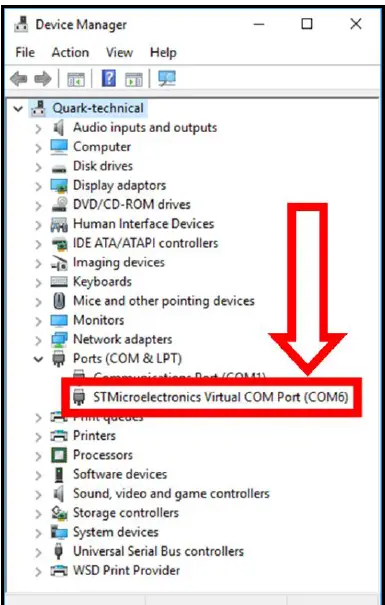
The drivers usually install automatically to the device if it is running Windows 10 (non-upgraded version). The A036 registers itself to the computer as a virtual serial com port. A new COM port will automatically show up in the device manager after plug in.
After the driver is installed, run the Device Manager and check the COM number (this is the number associated with the USB port being used. The port number is the number that Windows assigns as an input device. These can be generated randomly by the computer). The chart software may require the COM number in order to access the data.
The port number for the A036 can be found in Windows
‘Control Panel->System->Device Manager’ under ‘Ports (COM & LPT)’. Find the A036 in the list for the USB variant. To change this number, double click the A036 and select the ‘Port Settings’ tab. Click the ‘Advanced’ button and change the port number to the one required.
Checking the USB data flow: If desired, the USB data can always be checked with a terminal monitor application, like Putty or HyperTerminal. To do this, enter the following into the COM port settings: Bits per second: 38400bps, Data bits: 8, Parity: None, and Stop bits: 1 as shown below using HyperTerminal on Windows as an example
Mac:
For Mac OS X, the A036 will be recognized and shown as a USB modem. The ID can be checked with the following steps:
- Plug the A036 into a USB port and launch Terminal.app.
- Type: less /dev/*sub*
- The Mac system will return a list of USB devices. A036 will display as – “/dev/tty.usbmodemXYZ” where XYZ is a number. Nothing further needs to be done if it is listed.
Linux:
No driver is required for Linux. When plugged into the computer, A036 will show up as a USB CDC device on /dev/ttyACM0 or similar.
Status LED’S
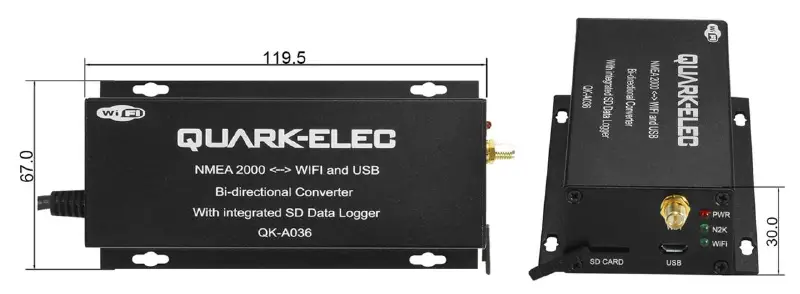
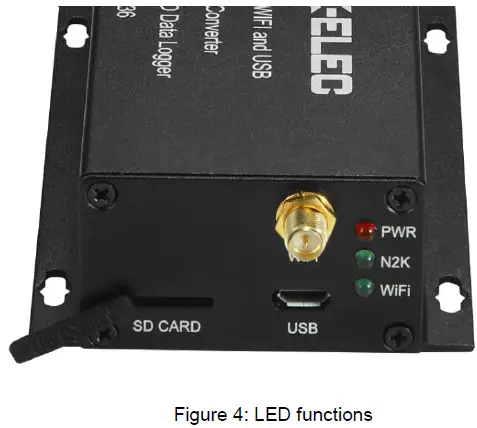
A036 features three LEDs which indicate power, NMEA 2000 and WiFi status respectively. Three LEDs turn on and then off after initialization. When operating, these LEDs flash as below:
- Power: Top LED (red) flashes at 3 second intervals.
- NMEA 2000: Middle LED (green) flashes for each valid NMEA 2000 PGN sent out on NMEA 2000 port.
- WiFi: Bottom LED (green) flashes for each valid message activated on USB and WiFi port.
Configuration (via USB)
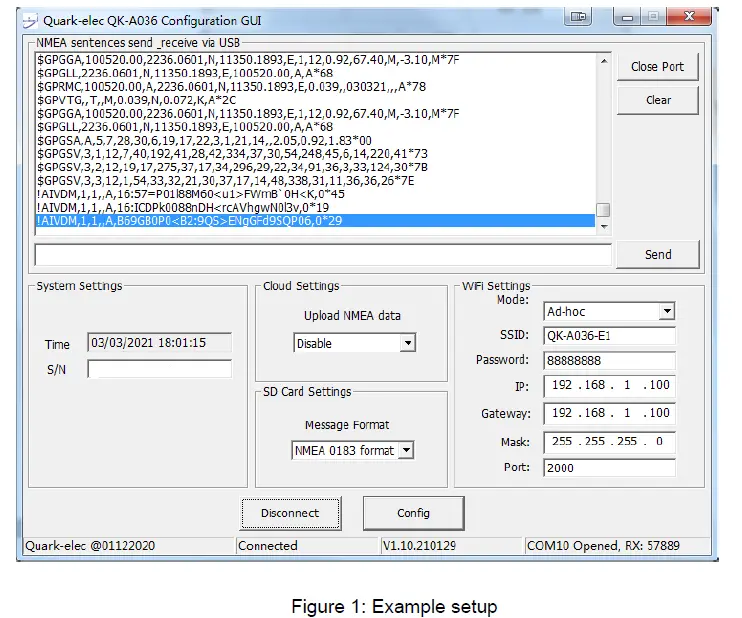
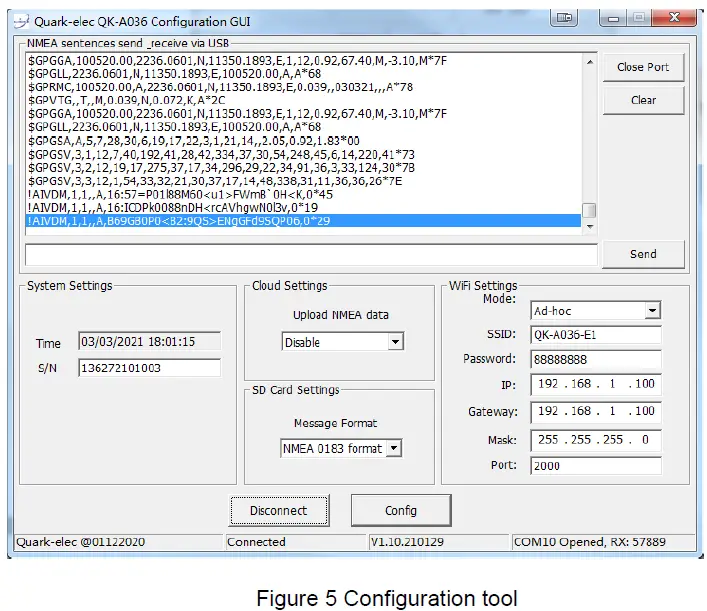
The Windows configuration tool can be used to setup the connection with the cloud, NMEA 0183 data format, and WiFi settings.
The Configuration tool can be found on the free CD and as a download from our website below. https://www.quark-elec.com/downloads/configuration-tools/
When the A036 is connected to a Windows PC and powered up, ‘A036 connected’ will be shown at the bottom of the Configuration software window. The software version will be shown on the bottom right-hand corner.
 Cloud Settings
Operators can turn the communication with Quark-cloud on or off. The saved NMEA data (in .txt file) will be automatically uploaded to the cloud once the device has been registered and connected to the Internet. This upload function can be disabled if desired.
WiFi
The A036 can be set up in either Ad-hoc (p2p), Station mode (Access Point), or Standby (disabled). See wireless connections chapter for information.
SD card settings
NMEA 2000 bus data can be saved as NMEA 0183 or PCDIN (raw NMEA 2000 messages) format on SD card.
USB – Monitoring NMEA Messages
Connect the A036 and then click ‘Open port’, all the sentences will be displayed in the application.
Once settings are complete the user must click ‘Config’ and then click ‘Disconnect’. Please restart A036 by un-plugging the NMEA 2000 connector. The unit is now ready for use.
Upgrading Firmware
The current firmware version can be verified through the configuration tool (When connected, the firmware version will show in the bottom of the Configuration software window).
To upgrade the firmware,
- Power up A036 and then connect it to Windows computer via USB.
- Run the Configuration software.
- Ensure the configuration tool is connected to the A036, and then click Ctrl+F7.Some laptop maybe need click Ctrl+F7+Fn.
- A new Window will pop up with a drive named ‘STM32’ or similar. Copy the firmware into this drive and wait around 10 seconds to make sure the full file has been copied.
- Close the window and the Configuration software.
- Reboot the A036, and then the new firmware will be active.
The upgrading process is complete.
Cloud Service
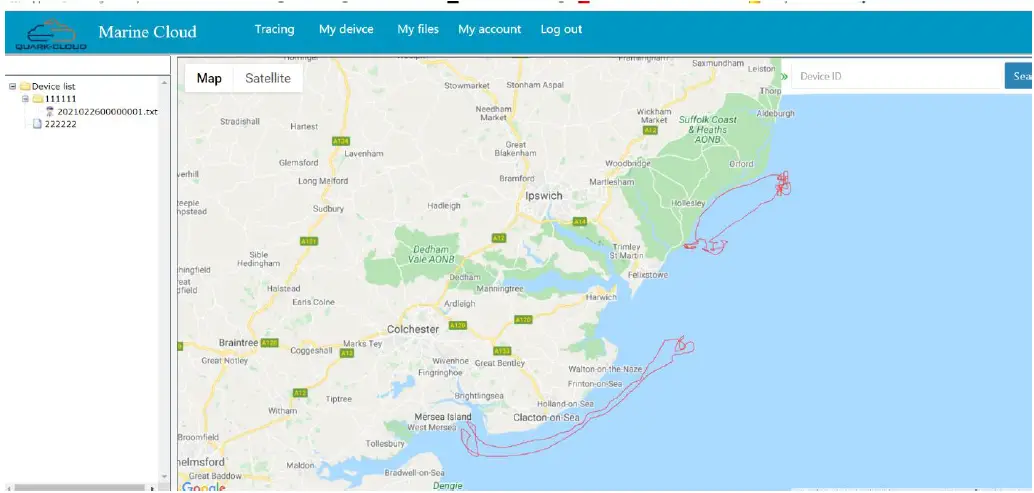
Quark-cloud (www.quark-cloud.com) allows people to back up the voyage data online. The sailing data can be uploaded to the cloud if an Internet connection is accessible.
Any NMEA data active on the NMEA 2000 backbone will be saved on the SD card and then uploaded to the cloud when the boat’s network is connected to the Internet. The data includes position, vessel course, wind speed/angle, depth, heading, AIS messages, atmospheric pressure, state of digital switching equipment, tanks, battery status, voltage, current, and engine information.
Cloud service allows boat owners to download the tracks and data from home, share the position with friends and family or monitor environmental conditions remotely. Cloud also allows a trained technician to be able to directly access the boat’s NMEA 2000 network and perform any diagnostic or analytical work accordingly. All these can be performed from a safe and remote place.
Accessing the cloud server is a new service that Quark-elec began providing in 2021. We are keen to keep developing it to provide more features. Please check out our website to get the latest news. One QK-A036 can have up to 8GB cloud memory for free in the first 24 months.
Conversion Lists
The conversion tables on the following pages list the supported NMEA 2000 PGN’s (parameter group numbers) and NMEA 0183 sentences. It is important to check the tables to confirm that the A036 will convert the sentences/PGNs required.
Through USB and WiFi the A036 will output in NMEA 0183 format, including all NMEA 0183 messages received and NMEA 0183 messages converted from the NMEA 2000 network.
The following is a typical PCDIN message format outputted through WiFi and USB. The chart software will convert this into more meaningful information.
—Received message: $PCDIN, 01F119, 00000000, 16,0064050800FFFF0C*5B—
| Header | PGN | Time Stamp | Source ID | Data | Termination | Check Sum |
| $PCDIN | 01F119 | 00000000 | 16 | 0064050800FFFF0C | * | 5B |
NMEA 0183 to NMEA 2000 conversions
The following NMEA 0183 to NMEA 2000 conversions are currently supported.
| NMEA 0183 sentence | Function | Converted to NMEA 2000 PGN/s |
| DBT | Depth Below Transducer | 128267 |
| DPT | Depth | 128267 |
| GGA | Global Positioning System Fix Data | 126992, 129025, 129029 |
| GLL | Geographic Position Latitude/Longitude | 126992, 129025 |
| GSA | GNSS DOP and Active Satellites | 129539 |
| GSV | GNSS Satellites in View | 129540 |
| HDG | Heading, Deviation & Variation | 127250 |
| HDM | Heading, Magnetic | 127250 |
| HDT | Heading, True | 127250 |
| MTW | Water Temperature | 130311 |
| MWD | Wind Direction & Speed | 130306 |
| MWV | Wind Speed and Angle (True or relative) | 130306 |
| RMB | Recommended Minimum Navigation Information | 129283,129284 |
| RMC* | Recommended Minimum Specific GNSS Data | 126992, 127258, 129025, 12902 |
| ROT | Rate Of Turn | 127251 |
| RPM | Revolutions | 127488 |
| RSA | Rudder Sensor Angle | 127245 |
| VHW | Water Speed and Heading | 127250, 128259 |
| VLW | Dual Ground/Water Distance | 128275 |
| VTG* | Course Over Ground and Ground Speed | 129026 |
| VWR | Relative (Apparent) Wind Speed and Angle | 130306 |
| XTE | Cross Track Error, Measured | 129283 |
| ZDA | Time & Date | 126992 |
| VDM/VDO | AIS Message 1,2,3 | 129038 |
| VDM/VDO | AIS Message 4 | 129793 |
| VDM/VDO | AIS Message 5 | 129794 |
| VDM/VDO | AIS Message 9 | 129798 |
| VDM/VDO | AIS Message 14 | 129802 |
| VDM/VDO | AIS Message 18 | 129039 |
| VDM/VDO | AIS Message 19 | 129040 |
| VDM/VDO | AIS Message 21 | 129041 |
| VDM/VDO | AIS Message 24 | 129809. 129810 |
Please note: some PGN sentences that are received require additional data before being sent.
NMEA 2000 to NMEA 0183 conversions
The following NMEA 2000 to NMEA 0183 conversions are currently supported.
| NMEA 2000 PGN | HEX code | Function | Converted to NMEA 0183Sentences |
| 126992 | 1F010 | System Time | ZDA |
| 127245 | 1F10D | Rudder | RSA |
| 127250 | 1F112 | Vessel Heading | HDG, VHW |
| 127251 | 1F113 | Rate of Turn | ROT |
| 127258 | 1F11A | Magnetic Variation | HDG |
| 128259 | 1F503 | Speed, Water referenced | VHW |
| 128267 | 1F50B | Water Depth | DBT, DPT |
| 128275 | 1F513 | Distance Log | VLW |
| 129025 | 1F801 | Position, Rapid Update | GLL |
| 129026 | 1F802 | COG & SOG, Rapid Update | VTG |
| 129029 | 1F805 | GNSS Position Data | GGA, GLL, GSA, RMC, ZDA |
| 129033 | 1F809 | Time & Date | ZDA |
| 129044 | 1F814 | Datum | DTM |
| 129283 | 1F903 | Cross Track Error | APB, RMB, XTE |
| 129284 | 1F904 | Navigation Data | RMB |
| 129291 | 1F90B | Set & Drift, Rapid Update | VDR |
| 129539 | 1FA03 | GNSS DOPs | GSA |
| 129540 | 1FA04 | GNSS Sats in View | GSV |
| 130306 | 1FD02 | Wind Data | MWV |
| 130310 | 1FD06 | Environmental Parameters | MDA, MTW |
| 130311 | 1FD07 | Environmental Parameters | MDA |
| 130312 | 1FD08 | Temperature | MDA, MTW |
| 129038 | 1F80E | AIS Message 1,2,3 | VDM/VDO |
| 129793 | 1FB01 | AIS Message 4 | VDM/VDO |
| 129794 | 1FB02 | AIS Message 5 | VDM/VDO |
| 129798 | 1FB06 | AIS Message 9 | VDM/VDO |
| 129039 | 1F80F | AIS Message 18 | VDM/VDO |
| 129040 | 1F810 | AIS Message 19 | VDM/VDO |
| 129809 | 1FB11 | AIS Message 24 (Part A) | VDM/VDO |
| 129810 | 1FB12 | AIS Message 24 (Part B) | VDM/VDO |
Please note: some PGN sentences that are received require additional data before being sent.
Specification
| Item | Specification |
| DC supply | 12.0V (+/-10%) |
| Average supply current | 45mA |
| Maximum supply current | 95mA |
| NMEA data format | ITU/ NMEA 2000 and 0183 format |
| NMEA 2000 port baud rate | 250kbps |
| NMEA 2000 Compatibility | Fully NMEA 2000 certified |
| LEN | 2 |
| WiFi mode | Ad-hoc, Station modes on 802.11 b/g |
| Security | WPA/WPA2 |
| Network Protocols | TCP |
| Cable Length NMEA 2000 | 1.0m |
| Operating Temperature | -20°C to +55°C |
| Storage Temperature | -30°C to +70°C |
| Recommended Humidity | 0 – 93% RH |
Limited Warranty and Notices
Quark-elec warrants this product to be free from defects in materials and manufacture for one year from the date of purchase. Quark-elec will, at its sole discretion, repair or replace any components that fail in normal use. Such repairs or replacement will be made at no charge to the customer for parts and labour.
The customer is, however, responsible for any transportation costs incurred in returning the unit to Quark-elec. This warranty does not cover failures due to abuse, misuse, accident or unauthorized alteration or repairs. A returns number must be given before any unit is sent back for repair.
The above does not affect the statutory rights of the consumer.
Disclaimer
This product is designed to aid navigation and should be used to augment normal navigational procedures and practices. It is the user’s responsibility to use this product prudently. Neither Quark-, nor their distributors or dealers accept responsibility or liability either to the products user or their estate for any accident, loss, injury or damage whatsoever arising out of the use or of liability to use this product.
Quark- products may be upgraded from time to time and future versions may therefore not correspond exactly with this manual. The manufacturer of this product disclaims any liability for consequences arising from omissions or inaccuracies in this manual and any other documentation provided with this product.
Document history
| Issue | Date | Changes / Comments |
| 1.0 | 24-12-2020 | Initial release |
| 1.01 | 03-03-2021 | Support Quark-cloud |
| 1.1 | 23-09-2021 | Support VDO sentence |
Glossary
- Ad-hoc WiFi, also known as ‘peer-to-peer’: devices communicate directly with each other without a router.
- IP: internet protocol (ipv4, ipv6)- explains which version
- IP Address: is a numerical label assigned to each device connected to a computer network.
- NMEA 0183: is a serial data interface operating at 4.8 Kbit/second utilizing standard asynchronous communications. It is an electrical and data standard for communication between marine electronics.
- NMEA 2000 / N2K: is a serial data network operating at 250 Kbit/second utilizing the Controller Area Network (CAN). The CAN bus was originally developed for the automotive industry but is now used in numerous industrial applications. It is a communications standard used for connecting marine sensors and display units within ships and boats and is generally plug-and-play.
- NMEA 2000 / N2K backbone: Used with NMEA 2000, the backbone is the main BUS supplying data and power to all the devices on the boat.
- PGN: Packet group number – used in the NMEA 2000 protocol instead of sentences
- Router: A router is a networking device that forwards data packets between computer networks. Routers perform the traffic directing functions on the Internet.
- Sentences: Used in NMEA 0183 protocol to transfer data between marine equipment.
- Station mode WiFi: devices communicate by going through an Access Point (AP) or router. This allows the user to view data while accessing other router functions such as other devices or internet.
- USB: cable for communication and power supply between devices.
Quark-elec (UK) Unit 7, the Quadrant Newark Close Royston, UK
SG8 5HL