 MIL-STD-810H Consumer Laptop
User Guide 
 ASUS Consumer Laptop
March 2023 version.
World’s Most Strictly Tested US Military-Grade Laptop Durability
ASUS MIL-STD-810H Testing
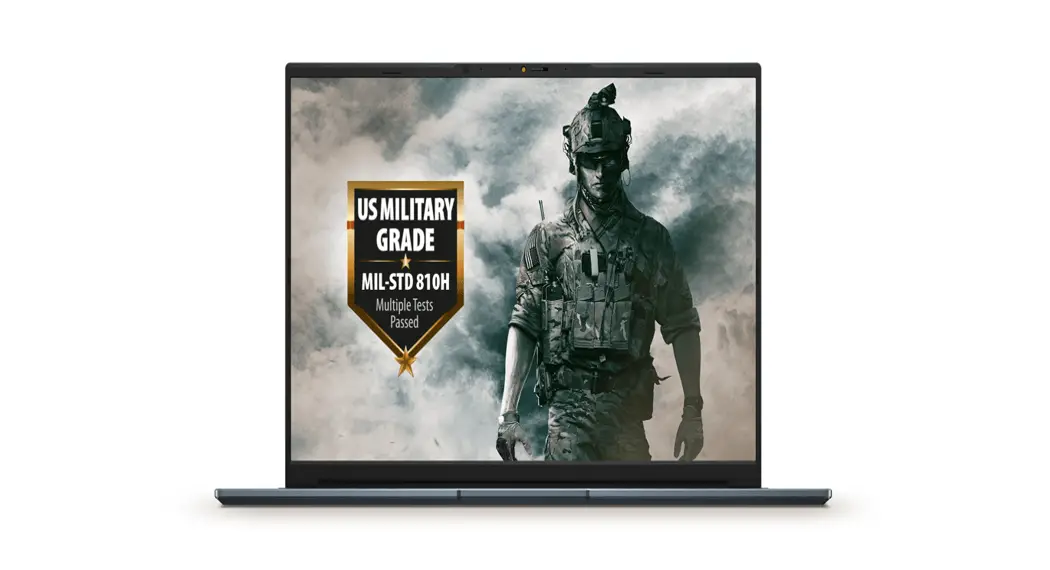
For greater reliability and durability, from 2023 onwards all ASUS consumer laptop models will be tested to the latest and strictest MIL-STD-810H military-grade standards. MIL-STD-810H is a US military standard developed by the US Department of Defense that provides durability testing advice for military equipment manufacturers. It includes a wide range of laboratory test procedures that replicate the environmental and physical situations that military equipment is expected to endure.
ASUS uses up to 12 test methods with 26 test procedures* in the full suite, including operation in harsh environmental conditions along with physical vibration and shock tests designed to mimic rough day-to-day handling. Compared to other laptop brands, ASUS consumer laptops have more a extensive testing regime and stricter compliance with the US military standard.
MIL-STD 810H
The new MIL-STD-810H standard is the eighth and most comprehensive version of the standard, concentrating on rigorous requirements for the durability of a product.
1. Shock Test “To ensure the device can physically and functionally withstand the shocks encountered in handling, transportation, and service environments and verify that parts of the materiel are not ejected during a crash situation.”
2. Vibration Test “To verify the device will function in and withstand the vibration exposures of a life cycle.”
3. High Temperature Test “To evaluate effects of high temperature conditions on device safety, integrity, and performance.”
Note
The testing regime includes the requirements of both military-grade standards and ASUS quality tests, and varies depending on device. MIL-STD-810 testing is conducted on selected ASUS products only. Note that the MIL-STD-810 testing helps to ensure the quality of ASUS products but does not indicate a particular fitness for military use. The test is performed under laboratory conditions. Any damage caused by attempts to replicate these test conditions would be considered accidental, and would not be covered by the standard ASUS warranty. Additional coverage is available with ASUS Premium Care.
* Some models tested only 8 test methods and 21 test procedures.
4. Low Temperature Test “To evaluate effects of low temperature conditions on device safety, integrity, and performance during storage, operation, and manipulation.”
5. Sand and Dust ‘H o evaluate the ability of device to resist the effects of dust (< 150 pm) and to be stored and operated in blowing sand (150 to 850 pm particle size) conditions.”
6. Altitude Test “To determine the device can withstand and/or operate in a low pressure environment and/or withstand rapid pressure changes.”
7. Freeze & Thaw Test “To determine the ability of device to withstand the effects of moisture phase changes between liquid and solid or moisture induced by transfer from a cold-to-warm or warm-to-cold environment.”
8. Humidity Test “To determine the resistance of device to the effects of a warm, humid atmosphere.”
9.Temperature Shock “To determine the device can withstand sudden changes in the temperature of the surrounding atmosphere without experiencing physical damage or deterioration in performance. ”
10. Solar Radiation “To determine the heating effects of solar radiation on device, and identify the actinic (photo degradation) effects of exposure to solar radiation.”
11. Mechanical Vibration Test “To determining the ability of device to withstand Navy shipboard equipment environment and excited vibration testing.”
12. Explosive Atmosphere “To demonstrate the ability of a device to operate in a fuel-air explosive atmosphere without causing ignition, and that an explosion or combustion reaction will be contained.”
Test Descriptions
ASUS laptops are tested to the most stringent US military-grade standards-, MIL-STD 81 OH, with up to 12 test methods and 26 procedures.*
| Test | Test Method | Test Reference | MIL-STD-810H Test Parameters |
| 1.Functional Shock | Method 516.8- Procedure I | Operational / Unpackage 3 shocks/axis/direction for a total of 18 shocks 40 Gs peak, 11 ms | |
| 2. Transportation shock- On road | Method 516.8- Procedure II | Non-operational / Package A total of 3 ~ 42 times shocks 5.1-7.6 Gs peak, 11 ms Terminal Peak Sawtooth | |
| Shock Test | 3. Fragility | Method 516.8- Procedure III | Non-operational / Unpackage 3 shocks/axis/direction for a total of 18 shocks 30~50 Gs peak Trapezoidal pulse |
| 4. Crash Hazard Shock | Method 516.8- Procedure V | Non-operational / Unpackage 2 shocks/axis/direction for a total of 12 shocks 75 Gs peak, 6 ms Terminal Peak Sawtooth | |
| 5. Bench Handling | Method 516.8- Procedure VI | Operational / Unpackage Drop Height : 100 mm | |
| 6. Two-wheeled tirailler | Method 514.8- Procedure I (Table 514.8C-IV.) | Non-operational / Unpackage Vibration: 5-500 Hz Duration : 32 min/axis | |
| Vibration Test | 7. Wheeled vehicle | Method 514.8- Procedure I (Table 514.8C-VII. ) | Non-operational / Unpackage Vibration: 5-500 Hz Duration : 40 min/axis |
| 8. Common carrier | Method 514.8- Procedure I (Table 514.8C-I. ) | Operational / Unpackage Vibration: 5-500 Hz Duration : 60 min/axis | |
| High Temperature Test | 9. Basic Hot Storage and Transit | Method 501.7- Procedure I | Non-operational Duration: 7 day exposure (7 X 24 hr. cycles) Temperature: 30~63°C Humidity: 5~44% |
| High Temperature Test | 10. Basic Hot Operational | Method 501.7- Procedure II | Operational Duration: 3 day exposure (3 X 24 hr. cycles) Temperature: 30~43°C cycling temperature exposure Humidity: 14~44% |
| 11. Hot Dry Storage and Transit | Method 501.7- Procedure I | Non-operational Duration: 7 day exposure (7 X 24 hr. cycles) Temperature: 33~71°C | |
| 12. Hot Dry Operational | Method 501.7Procedure II | Operational Duration: 3 day exposure (3 X 24 hr. cycles) Temperature: 32~49°C cycling temperature exposure | |
| Low Temperature Test | 13. Basic Climatic Storage and Transit | Method 502.7Procedure I | Non-operational Duration:7 day exposure (7 X 24 hr. cycles) Temperature: -25~ -33°C |
| 14. Basic Climatic Operational | Method 502.7Procedure II | Operational Duration: 3 day exposure (3 X 24 hr. cycles) Temperature: -21~ – 32°C | |
| 15. Cold Climatic Storage and Transit | Method 502.7Procedure I | Non-Operational Duration:7 day exposure (7 X 24 hr. cycles) Non-operational -37~ -46°C (-50°F) | |
| 16. Cold Climatic Operational | Method 502.7Procedure II | Operational Duration: 3 day exposure (3 X 24 hr. cycles) Operational -37~ -46°C (-50°F) | |
| Sand and Dust Test* | 17. Blowing Dust | Method 510.7Procedure I | Particle density: 10 +/- 7 g/m^3 Air velocity: 300~1750 ft/min Temperature: 60°C |
| 18. Blowing Sand | Method 510.7Procedure II | Particle density: 1.2g/m^3 Air velocity: 28m/s Temperature: 60°C | |
| Altitude Test | 19. Altitude Storage | Method 500.6Procedure I | Non-Operational Test Pressure: Equivalent to cabin altitude of 40,000ft Temperature: -20°C Duration: 12 hours |
| 20. Altitude Operation | Method 500.6ProcedureII | Operational Test Pressure: Equivalent to cabin altitude of 15,000ft Temperature: 5°C and 40°C Duration:12 and 12 hours |
| Freeze & Thaw Test | 21. Freeze & Thaw Test | Method 524.1- Procedure III | Humidity: 95% RH Temperature: 30°C/-10°C Duration: 1 hour, 3 cycles |
| Humidity Test | 22. Humidity Test | Method 507.6- Procedure II | Non-Operational Humidity: 95% RH Temperature: 30°C/60°C Duration:10 Days |
| Temperature Shock Test* | 23. Temperature Shock* | Method 503.7- Procedure I-C | Non-operational Temperature: -51°~71°C Duration: 1 hour, 3 cycles |
| Solar Radiation Test* | 24. Solar Radiation* | Method 505.7- Procedure I | Non-operational Spectral irradiance: 1120W/m2, 49°C Duration: 24hrs, 3 cycles |
| Mechanical Vibration Test | 25. Mechanical Vibration Test | Method 528.1-Procedure1 (Type 1) | Operational Frequency: 4-33 Hz Duration: 2 hours |
| Explosive Atmosphere* | 26.Explosive Atmosphere* | Method 511.7 – Procedure I | Operational Altitude: 15,000~33,00ft Explosive air: 95% n-Hexane |
ASUS Consumer Laptops Test Results
Tested Models
ASUS Zenbook
ASUS Zenbook Classic
ASUS Zenbook 14X OLED (UX3404V)
ASUS Zenbook 14 OLED (UX3402V)
ASUS Zenbook 14 OLED (UM3402Y AMD Ryzen 7000 Series model)
ASUS Zenbook Flip
ASUS Zenbook 14 Flip OLED (UP3404V)
ASUS Vivobook
ASUS Vivobook Pro
ASUS Vivobook Pro 16 OLED (K6602V)*
ASUS Vivobook Pro 15 OLED (K6502V)*
ASUS Vivobook S Flip
ASUS Vivobook S 16 Flip OLED (TP3604V)
ASUS Vivobook S 16 Flip OLED (TN3604Y)
ASUS Vivobook S 14 Flip OLED (TP3402V)*
ASUS Vivobook S 14 Flip OLED (TN3402Y)*
ASUS Vivobook Classic
ASUS Vivobook 16 (X1605P)
ASUS Vivobook 16 (X1605V)
ASUS Vivobook 14 OLED (X1404Z)
ASUS Vivobook Slate
ASUS Vivobook 13 Slate OLED (T3304G)
Test Result
The following tables summarize the MIL-STD-810H test methods that ASUS laptops passed.
ASUS Zenbook Classic
12 test methods with 26 test procedures
| Zenbook 14XOLED | Zenbook 14O LED | Zenbook 14O LED | ||
| Test | Test Method | UX3404V | UX3402V | UM3402Y |
| 516.8 Shock | 1. Functional shock 2. Transportation shock- on road 3. Fragility 4. Crash hazard shock 5. Bench handling | Pass Pass Pass Pass Pass | Pass Pass Pass Pass Pass | Pass Pass Pass Pass Pass |
| 514.8 Vibration | 6. Two-wheeled trailer 7. Wheeled vehicle 8. Common carrier | Pass Pass Pass | Pass Pass Pass | Pass Pass Pass |
| 501.7 High Temperature | 9. Basic hot storage and transit 10. Basic hot operational 11. Hot dry storage and transit 12. Hot dry operational | Pass Pass Pass Pass | Pass Pass PassPass | Pass Pass Pass Pass |
| 502.7 Low Temperature | 13.Basic climatic storage and transit 14. Basic climatic operational 15. Cold climatic storage and transit 16. Cold climatic operational | Pass Pass Pass Pass | Pass Pass Pass Pass | Pass Pass Pass Pass |
| 510.7 Sand and Dust | 17. Blowing dust 18. Blowing sand | Pass Pass | PassPass | Pass Pass |
| 500.6 Altitude Test | 19. Altitude storage 20. Altitude operation | Pass Pass | Pass Pass | Pass Pass |
| 524.1 Freeze / Thaw | 21. Freeze & thaw test | Pass | Pass | Pass |
| 507.6 Humidity | 22. Humidity test | Pass | Pass | Pass |
| 503.7 Temperature Shock | 23. Temperature shock | Pass | Pass | Pass |
| 505.7 Solar Radiation | 24. Solar radiation | Pass | Pass | Pass |
| 528.1 MechanicalVibrations Test | 25. Mechanical vibration test | Pass | Pass | Pass |
| 511.7 ExplosiveAtmosphere | 26. Explosive atmosphere | Pass | Pass | Pass |
Test Result
The following tables summarize the MIL-STD-810H test methods that ASUS laptops passed.
ASUS Zenbook Flip
12 test methods with 21 test procedures
| Vivobook Pro 16 OLED | Vivobook Pro 15OLED | ||
| Test | Test Method | K6602V | K6502V |
| 516.8 Shock | 1. Functional shock 2. Transportation shock- on road 3. Fragility 4. Crash hazard shock 5. Bench handling | Pass Pass Pass Pass Pass | Pass Pass Pass Pass Pass |
| 514.8 Vibration | 6. Two-wheeled trailer 7. Wheeled vehicle 8. Common carrier | Pass Pass Pass | Pass Pass Pass |
| 501.7 High Temperature | 9. Basic hot storage and transit 10. Basic hot operational 11. Hot dry storage and transit 12. Hot dry operational | Pass Pass Pass Pass | Pass Pass Pass Pass |
| 502.7 Low Temperature | 13.Basic climatic storage and transit 14. Basic climatic operational 15. Cold climatic storage and transit 16. Cold climatic operational | Pass Pass Pass Pass | Pass Pass Pass Pass |
| 507.6 Humidity | 17. Humidity test | Pass | Pass |
| 500.6 Altitude Test | 18. Altitude storage 19. Altitude operation | Pass Pass | Pass Pass |
| 524.1 Freeze / Thaw | 20. Freeze and thaw test | Pass | Pass |
| 528.1 Mechanical Vibrations Test | 21. Mechanical vibration | Pass | Pass |
Test Result
The following tables summarize the MIL-STD-810H test methods that ASUS laptops passed.
ASUS Vivobook Pro
12 test methods with 21 test procedures
| Vivobook Pro 16 OLED | Vivobook Pro 15OLED | ||
| Test | Test Method | K6602V | K6502V |
| 516.8 Shock | 1. Functional shock 2. Transportation shock- on road 3. Fragility 4. Crash hazard shock 5. Bench handling | Pass Pass Pass Pass Pass | Pass Pass Pass Pass Pass |
| 514.8 Vibration | 6. Two-wheeled trailer 7. Wheeled vehicle 8. Common carrier | Pass Pass Pass | Pass Pass Pass |
| 501.7 High Temperature | 9. Basic hot storage and transit 10. Basic hot operational 11. Hot dry storage and transit 12. Hot dry operational | Pass Pass Pass Pass | Pass Pass Pass Pass |
| 502.7 Low Temperature | 13.Basic climatic storage and transit 14. Basic climatic operational 15. Cold climatic storage and transit 16. Cold climatic operational | Pass Pass Pass Pass | Pass Pass Pass Pass |
| 507.6 Humidity | 17. Humidity test | Pass | – |
| 500.6 Altitude Test | 18. Altitude storage 19. Altitude operation | Pass Pass | Pass Pass |
| 524.1 Freeze / Thaw | 20. Freeze and thaw test | Pass | Pass |
| 528.1 Mechanical Vibrations Test | 21. Mechanical vibration | Pass | Pass |
Test Result
The following tables summarize the MIL-STD-810H test methods that ASUS laptops passed.
ASUS Vivobook S Flip
12 test methods with 26 test procedures
| Vivobook S 16 Flip OLED | Vivobook S 16 Flip OLED | ||
| Test | Test Method | TP3604V | TN3604Y |
| 516.8 Shock | 1. Functional shock 2. Transportation shock- on road 3. Fragility 4. Crash hazard shock 5. Bench handling | Pass Pass Pass Pass Pass | Pass Pass Pass Pass Pass |
| 514.8 Vibration | 6. Two-wheeled trailer 7. Wheeled vehicle 8. Common carrier | Pass Pass Pass | Pass Pass Pass |
| 501.7 High Temperature | 9. Basic hot storage and transit 10. Basic hot operational 11. Hot dry storage and transit 12. Hot dry operational | Pass Pass Pass Pass | Pass Pass Pass Pass |
| 502.7 Low Temperature | 13.Basic climatic storage and transit 14. Basic climatic operational 15. Cold climatic storage and transit 16. Cold climatic operational | Pass Pass Pass Pass | Pass Pass Pass Pass |
| 510.7 Sand and Dust | 17. Blowing dust 18. Blowing sand | Pass Pass | Pass Pass |
| 500.6 Altitude Test | 19. Altitude storage 20. Altitude operation | Pass Pass | Pass Pass |
| 524.1 Freeze / Thaw | 21. Freeze & thaw test | Pass | Pass |
| 507.6 Humidity | 22. Humidity test | – | – |
| 503.7 Temperature Shock | 23. Temperature shock | Pass | Pass |
| 505.7 Solar Radiation | 24. Solar radiation | Pass | Pass |
| 528.1 Mechanical Vibrations Test | 25. Mechanical vibration test | Pass | Pass |
| 511.7 ExplosiveAtmosphere | 26. Explosive atmosphere | Pass | Pass |
Test Result
The following tables summarize the MIL-STD-810H test methods that ASUS laptops passed.
ASUS Vivobook S Flip
12 test methods with 21 test procedures
| Vivobook S 14 Flip OLED | Vivobook S 14 FlipOLED | ||
| Test | Test Method | TP3402V | TN3402Y |
| 516.8 Shock | 1. Functional shock 2. Transportation shock- on road 3. Fragility 4. Crash hazard shock 5. Bench handling | Pass Pass Pass Pass Pass | Pass Pass Pass Pass Pass |
| 514.8 Vibration | 6. Two-wheeled trailer 7. Wheeled vehicle8. Common carrier | Pass Pass Pass | Pass Pass Pass |
| 501.7 High Temperature | 9. Basic hot storage and transit 10. Basic hot operational 11. Hot dry storage and transit 12. Hot dry operational | Pass Pass Pass Pass | Pass Pass Pass Pass |
| 502.7 Low Temperature | 13.Basic climatic storage and transit 14. Basic climatic operational 15. Cold climatic storage and transit 16. Cold climatic operational | Pass Pass Pass Pass | Pass Pass Pass Pass |
| 507.6 Humidity | 17. Humidity test | Pass | Pass |
| 500.6 Altitude Test | 18. Altitude storage 19. Altitude operation | Pass Pass | Pass Pass |
| 524.1 Freeze / Thaw | 20. Freeze and thaw test | Pass | Pass |
| 528.1 Mechanical Vibrations Test | 21. Mechanical vibration | Pass | Pass |
Test Result
The following tables summarize the MIL-STD-810H test methods that ASUS laptops passed.
ASUS Vivobook Classic
12 test methods with 26 test procedures
| Vivobook 16 | Vivobook 16 | Vivobook 14 OLED | ||
| Test | Test Method | X1605P | X1605V | X1404Z |
| 516.8 Shock | 1. Functional shock 2. Transportation shock- on road 3. Fragility 4. Crash hazard shock 5. Bench handling | Pass Pass Pass Pass Pass | Pass Pass Pass Pass Pass | Pass Pass Pass Pass Pass |
| 514.8 Vibration | 6. Two-wheeled trailer 7. Wheeled vehicle 8. Common carrier | Pass Pass Pass | Pass Pass Pass | Pass Pass Pass |
| 501.7 High Temperature | 9. Basic hot storage and transit 10. Basic hot operational 11. Hot dry storage and transit 12. Hot dry operational | Pass Pass Pass Pass | Pass Pass Pass Pass | Pass Pass Pass Pass |
| 502.7 Low Temperature | 13.Basic climatic storage and transit 14. Basic climatic operational 15. Cold climatic storage and transit 16. Cold climatic operational | Pass Pass Pass Pass | Pass Pass Pass Pass | Pass Pass Pass Pass |
| 510.7 Sand and Dust | 17. Blowing dust 18. Blowing sand | Pass Pass | Pass Pass | Pass Pass |
| 500.6 Altitude Test | 19. Altitude storage 20. Altitude operation | Pass Pass | Pass Pass | Pass Pass |
| 524.1 Freeze / Thaw | 21. Freeze & thaw test | Pass | Pass | Pass |
| 507.6 Humidity | 22. Humidity test | Pass | Pass | Pass |
| 503.7 Temperature Shock | 23. Temperature shock | Pass | Pass | Pass |
| 505.7 Solar Radiation | 24. Solar radiation | Pass | Pass | Pass |
| 528.1 Mechanical Vibrations Test | 25. Mechanical vibration test | Pass | Pass | Pass |
| 511.7 Explosive Atmosphere | 26. Explosive atmosphere | Pass | Pass | Pass |
Test Result
The following tables summarize the MIL-STD-810H test methods that ASUS laptops passed.
ASUS Vivobook Slate
12 test methods with 26 test procedures
| Vivobook 16 | Vivobook 16 | Vivobook 14 OLED | ||
| Test | Test Method | X1605P | X1605V | X1404Z |
| 516.8 Shock | 1. Functional shock 2. Transportation shock- on road 3. Fragility 4. Crash hazard shock 5. Bench handling | Pass Pass Pass Pass Pass | Pass Pass Pass Pass Pass | Pass Pass Pass Pass Pass |
| 514.8 Vibration | 6. Two-wheeled trailer 7. Wheeled vehicle 8. Common carrier | Pass Pass Pass | Pass Pass Pass | Pass Pass Pass |
| 501.7 High Temperature | 9. Basic hot storage and transit 10. Basic hot operational 11. Hot dry storage and transit 12. Hot dry operational | Pass Pass Pass Pass | Pass Pass Pass Pass | Pass Pass Pass Pass |
| 502.7 Low Temperature | 13.Basic climatic storage and transit 14. Basic climatic operational 15. Cold climatic storage and transit 16. Cold climatic operational | Pass Pass Pass Pass | Pass Pass Pass Pass | Pass Pass Pass Pass |
| 510.7 Sand and Dust | 17. Blowing dust 18. Blowing sand | Pass Pass | Pass Pass | Pass Pass |
| 500.6 Altitude Test | 19. Altitude storage 20. Altitude operation | Pass Pass | Pass Pass | Pass Pass |
| 524.1 Freeze / Thaw | 21. Freeze & thaw test | Pass | Pass | Pass |
| 507.6 Humidity | 22. Humidity test | Pass | Pass | Pass |
| 503.7 Temperature Shock | 23. Temperature shock | Pass | Pass | Pass |
| 505.7 Solar Radiation | 24. Solar radiation | Pass | Pass | Pass |
| 528.1 Mechanical Vibrations Test | 25. Mechanical vibration test | Pass | Pass | Pass |
| 511.7 Explosive Atmosphere | 26. Explosive atmosphere | Pass | Pass | Pass |
Test Result
The following tables summarize the MIL-STD-810H test methods that ASUS laptops passed.
ASUS Vivobook Slate
12 test methods with 26 test procedures
Vivobook 13 Slate OLED | ||
| Test | Test Method | T3304G |
| 516.8 Shock | 1. Functional shock 2. Transportation shock- on road 3. Fragility 4. Crash hazard shock 5. Bench handling | Pass Pass Pass Pass Pass |
| 514.8 Vibration | 6. Two-wheeled trailer 7. Wheeled vehicle 8. Common carrier | Pass Pass Pass |
| 501.7 High Temperature | 9. Basic hot storage and transit 10. Basic hot operational 11. Hot dry storage and transit 12. Hot dry operational | Pass Pass Pass Pass |
| 502.7 Low Temperature | 13.Basic climatic storage and transit 14. Basic climatic operational 15. Cold climatic storage and transit 16. Cold climatic operational | Pass Pass Pass Pass |
| 510.7 Sand and Dust | 17. Blowing dust 18. Blowing sand | Pass Pass |
| 500.6 Altitude Test | 19. Altitude storage 20. Altitude operation | Pass Pass |
| 524.1 Freeze / Thaw | 21. Freeze & thaw test | Pass |
| 507.6 Humidity | 22. Humidity test | Pass |
| 503.7 Temperature Shock | 23. Temperature shock | Pass |
| 505.7 Solar Radiation | 24. Solar radiation | Pass |
| 528.1 Mechanical Vibrations Test | 25. Mechanical vibration test | Pass |
| 511.7 Explosive Atmosphere | 26. Explosive atmosphere | Pass |
Note: A dash (-) in the Test Results tables indicates that the test was not passed by the laptop model. The testing regime includes the requirements of both military-grade standards and ASUS quality tests, and varies depending on device. MIL-STD-810 testing is conducted on selected ASUS products only. Note that the MIL-STD-810 testing helps to ensure the quality of ASUS products but does not indicate a particular fitness for military use. The test is performed under laboratory conditions. Any damage caused by attempts to replicate these test conditions would be considered accidental, and would not be covered by the standard ASUS warranty. Additional coverage is available with ASUS Premium Care.