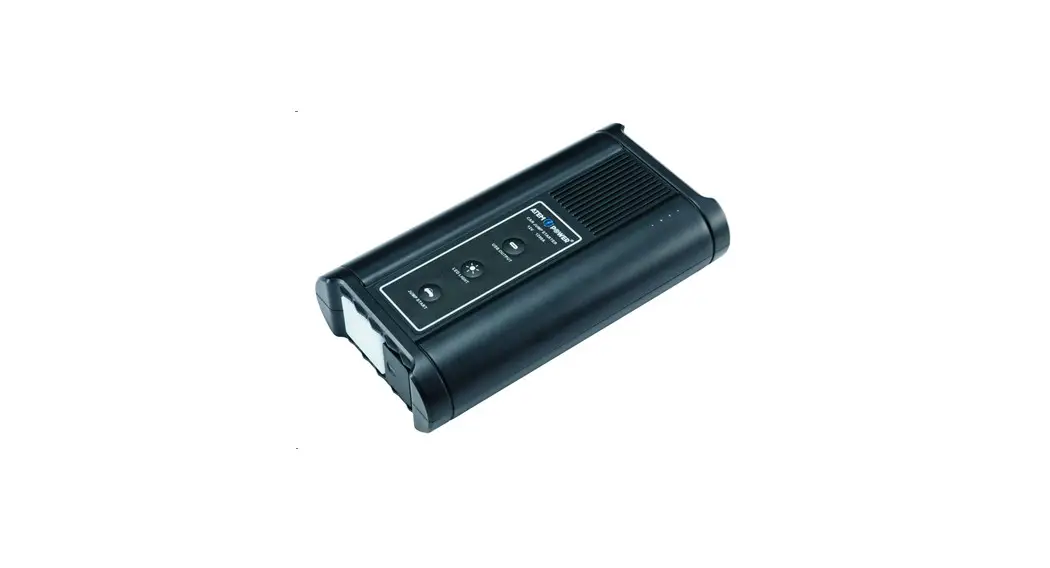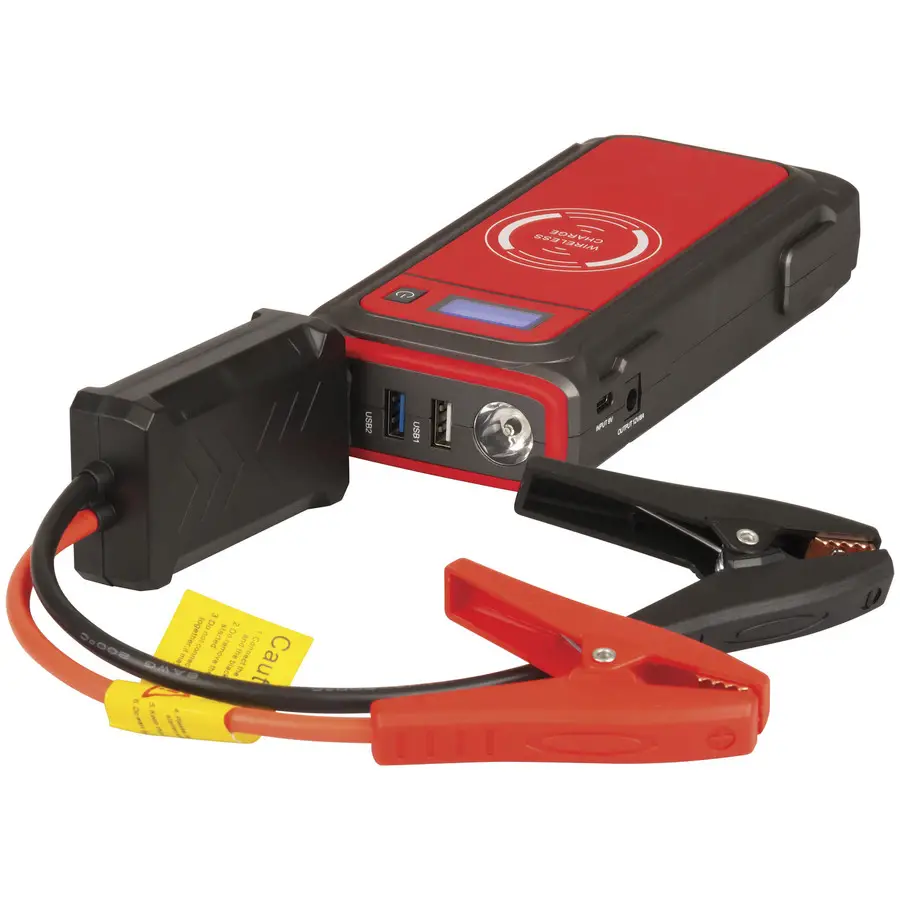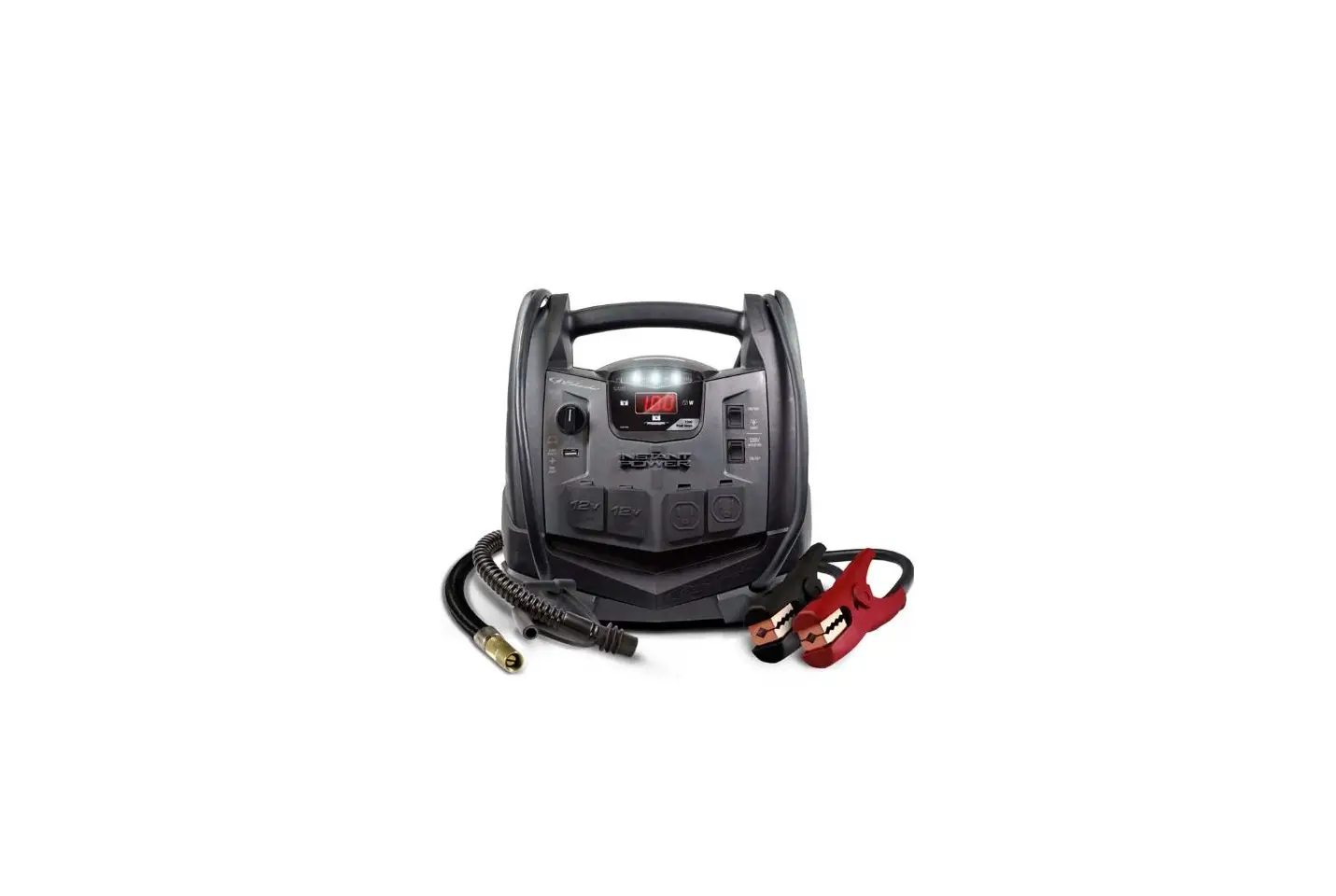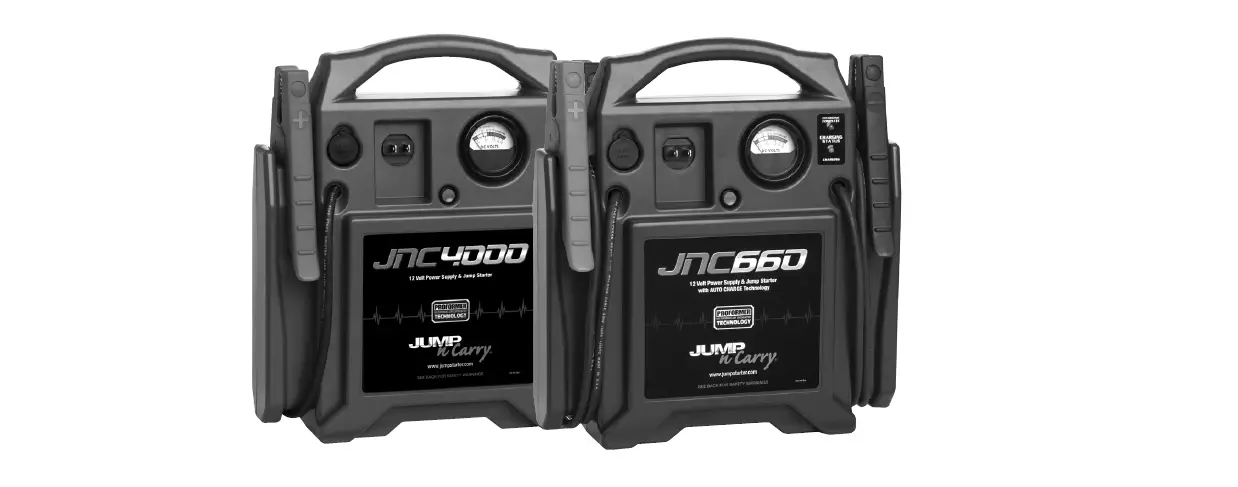
 Jump-N-Carry JNC660 12 Volt Power Supply Jump Starter User Manual
 Jump-N-Carry JNC660 12 Volt Power Supply Jump Starter User Manual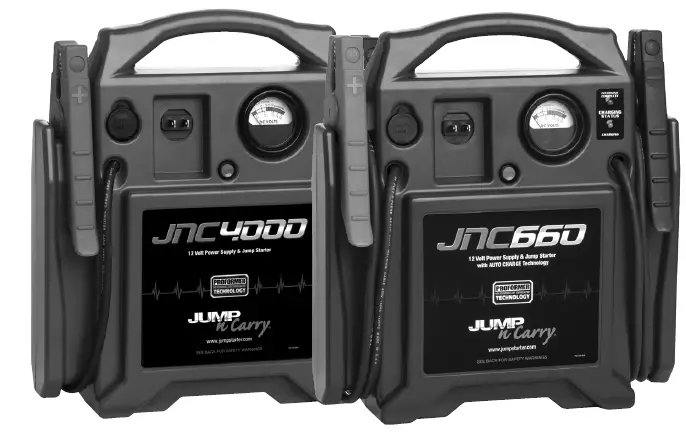
Charge the unit for 24 hours through the built-in charger upon opening the box, charge after every use, and charge before extended storage.
WARNING
Failure to follow instructions may cause damage or explosion, always shield your eyes. Read the entire instruction manual before use.
Warning:
This product contains chemicals, including lead, known to the State of California to cause cancer, birth defects and other reproductive harm.
Congratulations! You have just purchased a world-famous Jump-N-Carry jump starter, preferred by professionals around the world for its powerful output, exceptional service life, and rugged design. We have taken numerous measures in quality control and in our manufacturing processes to ensure that your product arrives in top condition and that it will perform to your satisfaction. In the rare event that your Jump-N-Carry contains a damaged or missing item, does not perform as specified, or requires warranty service, please call Technical Service at (913) 310-1050. Save your purchase receipt, it is required for warranty service. This unit has a sealed lead-acid battery that should be kept at full charge. Recharge when first purchased, immediately after each use, and every three months if not used. Failure to perform maintenance charges may cause the battery life to be reduced greatly.
Safety Information
 Read these instructions completely before using the Jump-N-Carry and save them for future reference. Before using the Jump-N-Carry to jump-start a car, truck, or boat or to power any equipment, read these instructions and the instruction manual/safety information provided by the car, truck, boat or equipment manufacturer. Following all manufacturers’ instructions and safety procedures will reduce the risk of accidents.
 Working around lead-acid batteries may be dangerous. Lead-acid batteries release explosive gases during normal operation, charging, and jump-starting. Carefully read and follow these instructions for safe use. Always follow the specific instructions in this manual and on the Jump-N-Carry each time you jump start using the Jump-N-Carry. All lead-acid batteries (cars, trucks,s, and boats) produce hydrogen gas which may violently explode in the presence of fire or sparks. Do not smoke, or use matches or a cigarette lighter while near batteries. Do not handle the battery while wearing vinyl clothing because static electricity sparks are generated when vinyl clothing is rubbed. Review all cautionary material on the Jump-N-Carry and in the engine compartment.
 Always wear eye protection, appropriate protective clothing, and other safety equipment when working near lead-acid batteries. Do not touch your eyes while working on or around lead-acid batteries.
- Always store clamps in their holsters, away from each other or common conductors. Improper storage of clamps may cause the clamps to come in contact with each other, or a common conductor, causing the battery to short circuit and generate high enough heat to ignite most materials.
- Use extreme care while working within the engine compartment, because moving parts may cause severe injury. Read and follow all safety instructions published in the vehicle’s Owner’s Manual.
- While the battery in the Jump-N-Carry is a sealed unit with no free liquid acid, batteries being jump-started with the Jump-N-Carry unit likely contain liquid acids which are hazardous if spilled.
 Read these instructions completely before using the Jump-N-Carry and save them for future reference. Before using the Jump-N-Carry to jump-start a car, truck, or boat or to power any equipment, read these instructions and the instruction manual/safety information provided by the car, truck, boat or equipment manufacturer. Following all manufacturers’ instructions and safety procedures will reduce the risk of accidents.
 Working around lead-acid batteries may be dangerous. Lead-acid batteries release explosive gases during normal operation, charging, and jump-starting. Carefully read and follow these instructions for safe use. Always follow the specific instructions in this manual and on the Jump-N-Carry each time you jump start using the Jump-N-Carry. All lead-acid batteries (cars, trucks,s, and boats) produce hydrogen gas which may violently explode in the presence of fire or sparks. Do not smoke, or use matches or a cigarette lighter while near batteries. Do not handle the battery while wearing vinyl clothing because static electricity sparks are generated when vinyl clothing is rubbed. Review all cautionary material on the Jump-N-Carry and in the engine compartment.
 Always wear eye protection, appropriate protective clothing, and other safety equipment when working near lead-acid batteries. Do not touch your eyes while working on or around lead-acid batteries.
General precautions for use:
- Someone should always be within range of your voice or close enough to come to your aid when you work near a lead-acid battery.
- Have plenty of fresh water and soap nearby in case battery acid contacts skin, clothing or eyes. Protective eyewear should always be worn when working near lead-acid batteries.
- If battery acid contacts skin or clothing, wash immediately with soap and water. If acid enters eye, immediately flood the eye with cold running water for at least 10 minutes and get medical attention immediately.
- Be extra cautious to reduce the risk of dropping a metal tool onto a battery. It might spark or short-circuit the battery or another electrical part that may cause an explosion.
- Remove personal metal items such as rings, bracelets, necklaces, and watches when working with a lead-acid battery. A lead-acid battery can produce a short-circuit current high enough to weld a ring or the like to metal, causing a severe burn.
- Use the Jump-N-Carry for jump-starting lead-acid batteries only. Do not use jump-starting dry-cell batteries that are commonly used with home appliances. These batteries may burst and cause injury to persons and damage to property.
- NEVER charge or jump-start a frozen battery.
- To prevent arcing, NEVER allow clamps to touch together or to contact the same piece of metal.
- Use of an attachment not recommended or sold by the manufacturer may result in a risk of damage to the unit or injury to personnel.
- When using the power extension cord, pull on the plug and never on the wire when disconnecting.
- Do not recharge the Jump-N-Carry with a damaged power extension cord. Replace it immediately.
- The Jump-N-Carry may be used under any weather condition – rain, snow, hot or cold temperatures.
- Do not submerge in water.
- Do not operate with flammables such as gasoline, etc.
- If the Jump-N-Carry receives a sharp blow or is otherwise damaged in any way, have it checked by a qualified service person. If the Jump-N-Carry is leaking battery acid, do
- ot ship it. Take it to the closest battery recycler in your area.
- Do not disassemble the Jump-N-Carry. Has it been checked by a qualified service person?
- The Jump-N-Carry should never be left in a completely discharged state for any period of time. Damage to the battery could be permanent, with poor performance as a result. When not in use, recharge every three (3) months.
- Always store, use and charge the Jump-N-Carry in an area where children cannot get to the unit.
Features
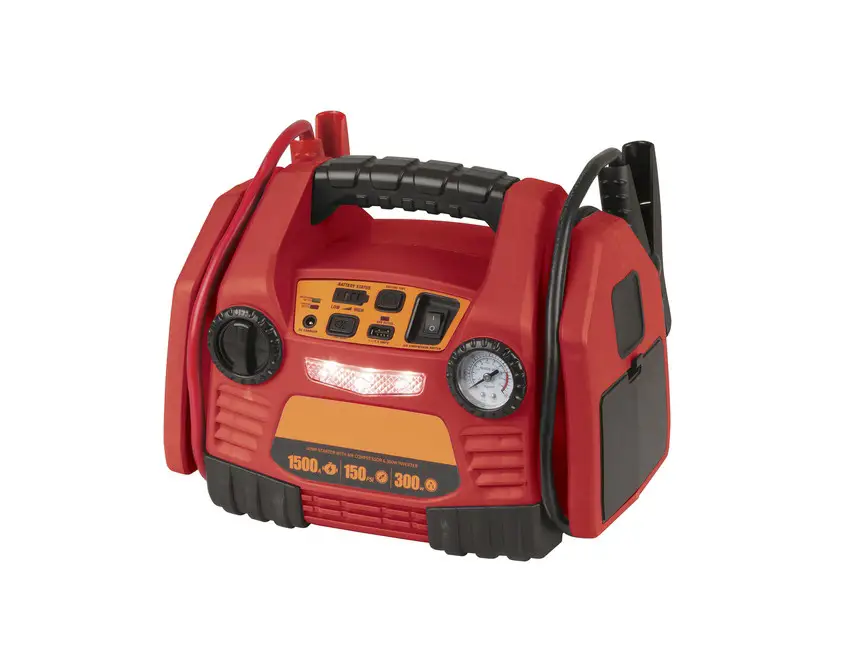
- The Jump-N-Carry provides plenty of power for starting vehicles – more than enough to start most cars.
- The Jump-N-Carry will power most 12 Vdc accessories equipped with a male 12 Volt plug. The DC outlet features automatic overload protection.
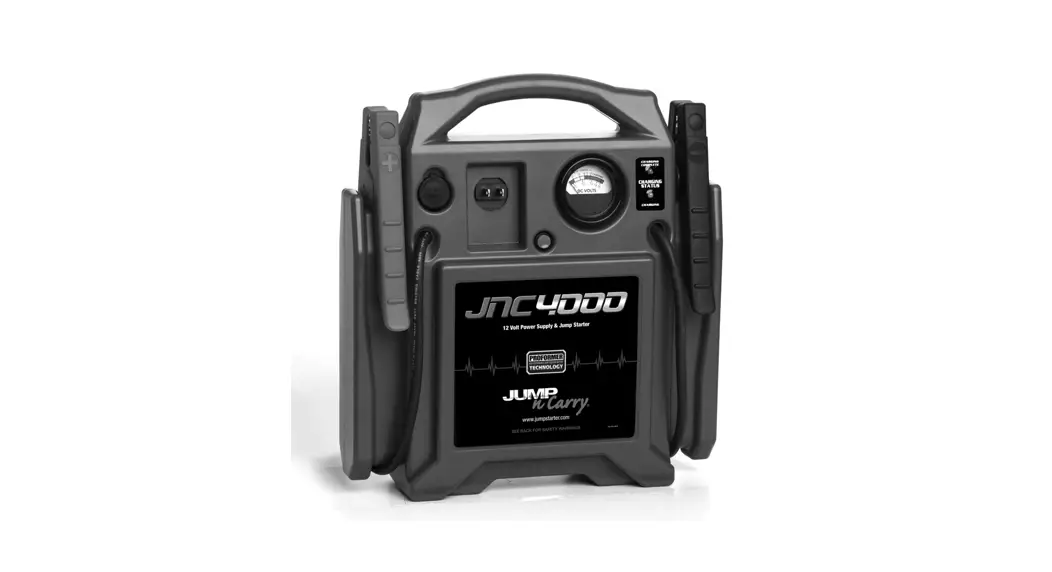
- The unit features a test switch and battery status gauge, which provides an approximate indicator of the battery’s state of charge.
- The Jump-N-Carry features convenient side-mounted holsters with cable tracks for easy cable and clamp management. Always re-wrap cables and re-holster the clamps after each use.
- The Jump-N-Carry contains the latest technology with its 12 Volt sealed, non-spillable battery and may be stored in any position.
Battery Status Gauge
Press and hold the red test button to display the battery status on the gauge.
- The Green shaded area indicates the unit is capable of jump-starting.
- The Yellow shaded area indicates the unit needs to be recharged.
- The Red shaded area indicates the unit must be recharged immediately.
You can also get a quick check of the vehicle’s charging system by depressing the red test button while connected to a running vehicle and observing the gauge.
Recharging
Note: Upon initial purchase, charge your Jump-N-Carry until the green CHARGED LED lights (JNC660) or for a minimum of 24 hours (JNC4000). There are two ways to charge your Jump-N-Carry. The recommended method is recharging using AC power, with a household extension cord connected to the built-in charger. An alternative method is through the DC power outlet using the provided 12 Volt Male-Male Extension Cord. In some cases, care must be taken not to overcharge the Jump-N-Carry, as noted.
Charging using the built-in charger (recommended method). With this method, an extension cord (not included) is connected to the Jump-N-Carry through the built-in charger located on the front of the unit.
- Connect the female end of the extension cord to the charger plug on the front of the unit. The charger plug has two blades and resembles a standard household plug that would fit into a 120 Vac wall receptacle.
- Connect the male end to the extension cord to the AC outlet. an amber LED will light to show the charging phase is in process. (JNC660 only)
- Charge until the green LED lights to show that the charging process is complete and has entered maintenance mode (new style JNC660 models only) or as noted in the following table (JNC4000 and old style – no LED indicators – JNC660 models).
- SUGGESTED AC RECHARGE TIMES (JNC4000 and older JNC660 models)


Note: We do not recommend charging the unit for more than 24 hours under normal usage. However, under extreme usage or high discharge situations, recharge the unit for up to 36 hours. This is not applicable to JNC660 models with auto charging, which cannot be overcharged. These models can remain connected continuously with no adverse consequences. Charging using the supplied 12 Volt Male-Male Extension Cord. This alternative charging method may be used when access to an AC outlet is unavailable.
- Start the vehicle’s engine.
- Plug one end of the 12 Volt Male-Male Extension Cord into the Jump-N-Carry 12 Volt outlet and the other end into the vehicle’s 12 Volt power port.
- Charge the unit based on the suggested recharge times shown in the following table.
Note: DO NOT OVERCHARGE! You must frequently monitor the charging process to ensure the unit is not overcharged. Overcharging will damage your Jump-N-Carry.
Jump Starting Instructions
Note: For optimum performance, do not store your Jump-N-Carry below 50°F when using as a jump starter. NEVER charge or jump-start a frozen battery.
- Use in a well-ventilated area.
- Shield’s eyes. Always wear protective eyewear when working near batteries.
- Review this instruction manual and the instruction/safety manual provided by the manufacturer of the vehicle being jump-started.
- Turn the ignition off before making cable connections.
- Clamp the positive (red +) clamp to the positive terminal on the vehicle battery (for the negative ground system), or an alternate vehicle starting point as recommended by the vehicle manufacturer.
- Clamp the negative (black –) clamp to the vehicle ground (non-moving metal part, such as the vehicle frame).
- Make sure the cables are not in the path of moving engine parts (belts, fans, etc.).
- Stay clear of batteries while jump-starting.
- Start the vehicle (turn on the vehicle ignition).
Note: If the vehicle doesn’t start within 6 seconds, let the Jump-N-Carry cool for 3 minutes before attempting to start the vehicle again or you may damage the Jump-N-Carry. - When the vehicle is started, disconnect the negative (–) battery clamp from the vehicle frame and return it to its holsters.
- Disconnect the positive (+) clamp and return it to its holster.
12 Volt DC Power
- Your Jump-N-Carry is an essential tool for all who replace automobile batteries. Most vehicles have electronic components with memory, such as alarm systems, computers, radios, phones, etc., and when the vehicle’s battery is replaced, the memory is lost. However, if the Male-Male Extension Cord is connected from the Jump-N-Carry to the 12 Volt outlet on the vehicle, the memory can be saved.
Note: To use the Jump-N-Carry for this purpose, the chosen outlet must be live when the vehicle is turned OFF. On some vehicles, 12 Volt outlets are deactivated when the vehicle is turned OFF. - Your Jump-N-Carry is also a portable power source for all 12 Vdc accessories equipped with a male 12 Volt plug. The DC outlet on the Jump-N-Carry has automatic overload protection.
- When your Jump-N-Carry is used with a DC to AC power inverter, it can operate appliances normally powered by 120 Vac or 220 Vac. Recommended inverter for the portable power source is 400 watts maximum. For more information, contact your nearest Jump-N-Carry dealer.
Performance and Temperature
The performance of your Jump-N-Carry will depend upon several factors:
- A good, solid connection between the Jump-N-Carry clamps and the battery and ground connections are a must. Moving the clamps back and forth while connecting to the battery will help create a better connection.
- Clean connections between your vehicle or equipment battery and its terminals are very important. For an optimal connection, corrosion (soft grayish-white build-up) on battery terminals must be removed. With the ignition turned off, disconnect the battery cables and clean the terminals and battery posts with a baking soda solution.
- All batteries are affected by temperature changes, and the small, lightweight battery in the Jump-N-Carry is more sensitive to storage temperature than a standard automotive battery. Temperatures above 70ºF decrease amperage output. The ideal storage environment is room temperature or 68ºF.
Troubleshooting/FAQs
- Q. What should I do if the Jump-N-Carry will not hold a charge?
Load-test the battery. Charge the battery 24 hours before load testing. Connect a load tester (available at your local auto parts store) to the Jump-N-Carry clamps to check battery amperage. Depending on the model of the load tester, your load testing procedure may vary. A generic load test would bring the voltage down to 9.0 volts and result in an amp reading of 70 amps for 6 seconds. Repeat this load test every 10 minutes for a total of three tests. If the amperage has dropped below 50 amps on the last test, suspect a bad or weak battery. - Q. What is the ideal use for the Jump-N-Carry?
The Jump-N-Carry performs strongly when a vehicle’s battery needs an extra boost because light or radio was left on, or when a vehicle has been sitting for a long period of time. The Jump-N-Carry will start vehicles without any other batteries present, but the primary use is for an extra boost. - Q. Will the Jump-N-Carry start every vehicle?
No. In addition to a dead battery, a car may have other mechanical problems that would prevent the Jump-N-Carry from starting the vehicle. - Q. How often should I recharge the Jump-N-Carry?
To maximize battery life, charging after every use is recommended. The Jump-N-Carry should not be left in a discharged state. The battery in the Jump-N-Carry has no memory problems and should not be treated as a rechargeable tool (cordless drills, camcorders, etc.) - How many jump starts can I get from the Jump-N-Carry before recharging?
A large number of factors affect this answer, including the following: the length of time for each jump-start, the charge level of the original battery, the length of time between jump-starts, the temperature of the vehicles being jump-started (winter cold makes for difficult starting), the size of the engines (4-cycle, 6-cycle, 8-cycle, etc.), the mechanical condition of the engine and starter, and more. These factors must all be weighed on an individual basis before an accurate answer can be given. It’s feasible to get 10-30 starts (individual’s results will differ) from a single charge, but this violates the rule of immediate charging after every use.
Testing The Battery
After fully charging the battery (see “Recharging” section), apply a 100 amp load to the unit for a period of 6 seconds, while monitoring the battery voltage. The battery is good if the voltage is 9.5 Vdc or higher.
Storage
The Jump-N-Carry may be stored virtually anywhere and in any position. However, take precautions to ensure that the positive and negative clamps do not come into contact with each other or a common metal surface. We recommend storing the Jump-N-Carry in the box in which it was originally received. Always be sure to re-wrap cables and re-holster clamps after each use and prior to storage.
Battery Replacement and Disposal
This unit contains a sealed non-spillable lead-acid battery. This battery must be recycled. Consult your state or local government concerning regulations for proper disposal. The battery inside this product is a sealed lead-acid battery. It is required by law that must be complied with throughout the United States, your individual state or government may have additional regulations to be followed. instructions are provided below, and take it to your local recycling center for proper recycling or disposal. If you don’t have a local recycling center that handles sealed lead-acid batteries, contact your local environmental agency for instructions.
Removal instructions:
Begin by making sure that both clamps are securely placed in a position that ensures they will not come into contact with each other.
- Lay the Jump-N-Carry down on its front. On the back of the unit, locate the 13 screws that hold the case together (including a total of 6 screws located in the cable management tracks).
- Remove the screws, then lift off the back half of the case, lifting first from the bottom.
- On the top of the battery are two terminals, each with wires connected to them. Disconnect these wires from the battery by removing the bolts that hold them to the battery terminals. To prevent accidental arcing, be careful not to touch both battery terminals with the tools being used to remove the bolts.
- Lift the battery out of the front half of the case.
Jump-N-Carry Limited Warranty
Clore Automotive warrants this product to be free from defects in material or workmanship for a period of one year from the date of the original end-user purchase. This warranty extends to each person who acquires lawful ownership within one year of the original retail purchase but is void if the product has been abused, altered, misused or improperly packaged and damaged when returned for repair. This warranty applies to the product only and does not apply to any accessory items included with the product which are subject to wear from usage; the replacement or repair of these items shall be at the expense of the owner.
THE TERMS OF THE CLORE AUTOMOTIVE LIMITED WARRANTY CONSTITUTE THE BUYER’S SOLE AND EXCLUSIVE REMEDY. THE IMPLIED WARRANTIES OF MERCHANTABILITY AND FITNESS FOR A PARTICULAR PURPOSE ARE LIMITED IN DURATION TO THIS EXPRESS WARRANTY. AFTER 1 YEAR FROM THE DATE OF PURCHASE, ALL RISK OF LOSS FOR WHATEVER REASON SHALL BE PUT UPON THE PURCHASER.
CLORE AUTOMOTIVE SHALL NOT BE LIABLE FOR INCIDENTAL AND CONSEQUENTIAL DAMAGES UNDER ANY CIRCUMSTANCES: CLORE AUTOMOTIVE’S LIABILITY, IF ANY, SHALL NEVER EXCEED THE PURCHASE PRICE OF THIS PRODUCT REGARDLESS OF WHETHER LIABILITY IS PREDICATED UPON BREACH OF WARRANTY (EXPRESS OR IMPLIED), NEGLIGENCE, STRICT TORT OR ANY OTHER THEORY. Some states do not permit the limitation of warranties or the limitation of consequential or incidental damages, so the above disclaimer and limitation may not apply to you. This warranty gives you specific legal rights, and you may also have other rights which vary from state to state.
For Warranty or Service
If this product fails within the first 30 days after retail purchase due to a defect in material or workmanship, return it to your place of purchase for an exchange. From day 31 to day 365 after retail purchase, contact Clore Automotive Technical Service at the number below for warranty service. A valid, dated sales receipt is required to obtain service under this warranty. For the best service and to receive periodic product updates, follow the instructions below to register your purchase: Please visit: www.cloreregistration.com