Wallys DR882 Wireless AC AN MiniPCIE Standard Card User Manual
Features
- Featuring with industrial-grade Atheros’s QCA9882-BR4A chipset
- Integrated with 2x 2 5G high power Radio Card
- Frequency Range: Band 1:5150~5250MHz, Band 4: 5725~5850MHz
- 2 x 5G MMCX Connectors
- 20MHz/40MHz/80MHz Bandwidth
- Support 11AC/A/N
- RoHS compliance ensure a high level protection of human health and the environment from risks that can be posed by chemicals
Applications
- Security Surveillance
- Commercial radio coverage
- Hotel Wireless application
- Country coverage
- Forest fire protection engineering
- Some special scene application
Product Description
DR882-NAS based on QCA9882-BR4A chipset is an enterprise wireless module integrated with 2×2 5G high power Radio card designed specifically to provide users with mobile access to high-bandwidth video streaming, voice, and data transmission for office and challenging RF environment in factories, warehouses establishment.
Absolute Maximum Rating
| Parameter | Rating | Unit |
| Supply Voltage | 3.3V(MINIPCIE) | V |
| Operating Temperature Range | -40 to +70 | ºC |
| Storage Temperature Range | -65 to +105 | ºC |
| Operating Humidity Range | 5 to +95 (non-condensing) | % |
| Storage Humidity Range | 0 to +90 (non-condensing) | % |
| Symbol | Parameter |
| CPU | QCA9882-BR4A |
| Antenna Connector | 2 x 5G MMCX connectors |
| ROHS Compliance | YES |
| Dimension | 50mm x 30mm x 16mm |
Radio TX Specifications(5180MHz-5825MHz)
| Operating Mode | frequency range | Tune-up Output Power |
| 802.11a | 5150~5250 | 17dBm |
| 5725~5850 | 17dBm | |
| 802.11ac20 | 5150~5250 | 17dBm |
| 5725~5850 | 17dBm | |
| 802.11n-HT20 | 5150~5250 | 17dBm |
| 5725~5850 | 17dBm | |
| 802.11ac40 | 5150~5250 | 16.50dBm |
| 5725~5850 | 17dBm | |
| 802.11n-HT40 | 5150~5250 | 17dBm |
| 5725~5850 | 17dBm | |
| 802.11ac80 | 5210 | 16.50dBm |
| 5775 | 16.50dBm |
Radio RX Specifications(5180MHz-5825MHz)
| Operating Mode | Data Rate | Sensitivity |
| 802.11a | 6 Mbps | -96dBm |
| 54 Mbps | -78dBm | |
| 802.11n HT20 | MCS0, MCS8 | -92dBm |
| MCS7, MCS15 | -73dBm | |
| 802.11n HT40 | MCS0, MCS8 | -90dBm |
| MCS7, MCS15 | -70dBm | |
| 802.11AC HT40 | MCS0, MCS10,MCS20 | -90dBm |
| MCS9,MCS19,MCS29 | -67dBm | |
| 802.11AC HT80 | MCS0, MCS10,MCS20 | -88dBm |
| MCS9,MCS19,MCS29 | -62dBm |
GPIO Pin Mapping
| GPIO Pin | Function | ||
| GPIO0 | WLAN_DIS | ||
| GPIO1 | WLAN_LED | ||
| GPIO2 | MCI_CLK_IN | ||
| GPIO3 | MCI_CLK_OUT | ||
| GPIO4 | MCI_DATA_OUT | ||
| GPIO5 | MCI_DATA_IN | ||
| GPIO12 | TMS | ||
| 13 | TCK | ||
| 14 | TDI | ||
| 15 | TDO | ||
| 16 | CPU_WARM_RESET / JTEG RESET | ||
| 17 | GPIO17_BT_LED | ||
| 19 | ANT_A | ||
| 20 | ANT_B | ||
| 21 | FEM_BS | ||
| 22 | FEM_MODE |
MiniPCIe Slot Pin Assignment
| TOP Side | Bottom Side | ||
| 1 | PCIE_WAKE_L | 2 | VCC_3V3 |
| 3 | NC | 4 | GND |
| 5 | NC | 6 | NC |
| 7 | PCIE_CLKREQ_L | 8 | NC |
| 9 | GND | 10 | NC |
| 11 | PCIE_REFCLK_N | 12 | NC |
| 13 | PCIE_REFCLK_P | 14 | NC |
| 15 | GND | 16 | NC |
| Mechanical key | |||
| 17 | NC | 18 | GND |
| 19 | NC | 20 | GPIO0_WLAN_DIS |
| 21 | GND | 22 | PCIE_RST_L |
| 23 | PCIE_TX_N | 24 | VCC_3V3 |
| 25 | PCIE_TX_P | 26 | GND |
| 27 | GND | 28 | NC |
| 29 | GND | 30 | NC |
| 31 | PCIE_RX_P | 32 | NC |
| 33 | PCIE_RX_N | 34 | GND |
| 35 | GND | 36 | NC |
| 37 | GND | 38 | NC |
| 39 | VCC_3V3 (RESERVED) | 40 | GND |
| 41 | VCC_3V3 (RESERVED) | 42 | NC |
| 43 | GND | 44 | GPIO1_WLAN_LED |
| 45 | NC | 46 | GPIO17_BT_LED |
| 47 | NC | 48 | NC |
| 49 | NC | 50 | GND |
| 51 | NC | 52 | VCC_3V3 |
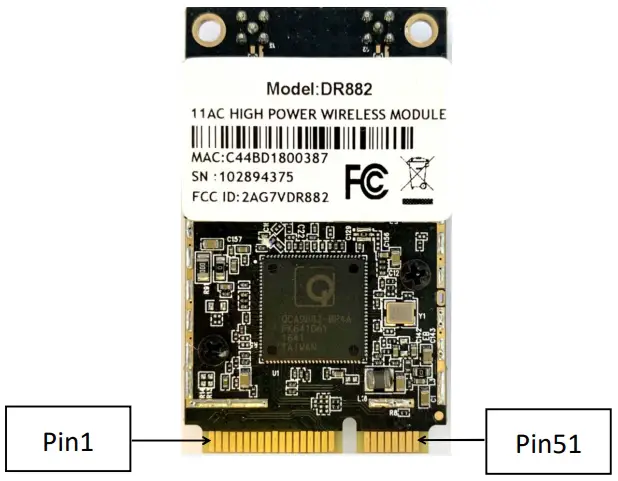
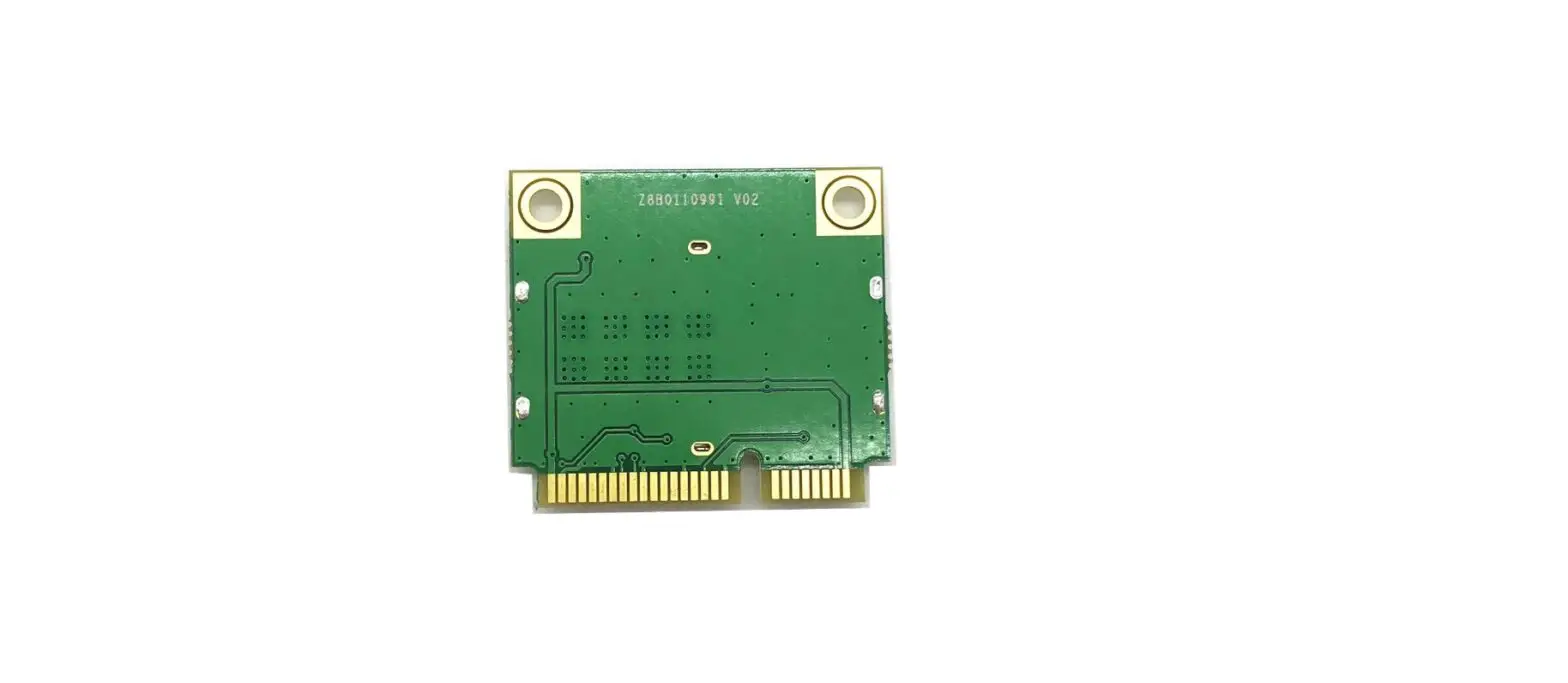
- the picture show us the Pin 1 and the pin51,the pin numbers are increasing by odd numbers on the top side;
- and increasing by even numbers from Pin2 to Pin52 on the bottom side;the pin2 is on the bottom of the pin1
OEM/Integrators Installation
This module has been tested and found to comply with 15.407 requirements for Limited module procedures . This module can work with 5G(Band 1, Band 4) but the two band can’t work together
Summarize the specific operational use conditions
This module can be used in Commercial radio coverage and other equipment. The
input voltage to the module should be nominally DC 3.39 ,the ambient temperature of the module is -40°~70°.And if the antenna needs to be changed, the certification should be re-applied.
Limited module procedures
This module can be used in Commercial radio coverage and other equipment. Normally host device should provide a power supply in range 3.3VDC for this module. The limited module manufacturer will reviews detailed test data or host designs prior to giving the host manufacturer approval.
Trace antenna designs
- N/A
RF exposure considerations
This equipment complies with FCC radiation exposure limits set forth for an uncontrolled environment .This equipment should be installed and operated with minimum distance 20cm between the radiator& your body. If the device built into a host as a portable usage, the additional RF exposure evaluation may be required as specified by 2.1093.
Antennas
- Antenna 1:
- Omni Antenna:4.0 dBi
- Antenna 2&3 :
- Directional Antenna: 19.0 dBi
Label and compliance information
When the module is installed in the host device, the FCC ID label must be visible through a window onthe final device or it must be visible when an access panel, door or cover is easily re-moved. If not, a second label must be placed on the outside of the final device that contains the following text: “Contains FCC ID: 2AG7VDR882”. The FCC ID can be used only when all FCC ID compliance requirements are met.
Information on test modes and additional testing requirements
The modular transmitter has been fully tested by the module grantee on the required
number of channels,modulation types, and modes, it should not be necessary for the host installer to re-test all the available transmitter modes or settings. It is recommended that the host product manufacturer, installing the modular transmitter,perform some investigative measurements to confirm that the resulting composite system does not exceed the spurious emissions limits or band edge limits (e.g., where a different antenna may be causing additional emissions).
The testing should check for emissions that may occur due to the intermixing of emissions with the other transmitters, digital circuitry, or due to physical properties of the host product (enclosure). This investigation is especially important when integrating multiple modular transmitters where the certification is based on testing each of them in a stand-alone configuration. It is important to note that host product manufacturers should not assume that because the modular transmitter is certified that they do not have any responsibility for final product compliance.
If the investigation indicates a compliance concern the host product manufacturer is
Additional testing, Part 15 Sub part B disclaimer The final host / module combination need to be evaluated against the FCC Part 15B criteria for unintentional radiators in order to be properly authorized for operation as a Part 15 digital device.
The host integrator installing this module into their product must ensure that the final composite product complies with the FCC requirements by a technical assessment or evaluation to the FCC rules, including the transmitter operation and should refer to guidance in KDB 996369. For host products with certified modular transmitter, the frequency range of investigation of the composite system is specified by rule in Sections 15.33(a)(1) through (a)(3), or the range applicable to the digital device, as shown in Section 15.33(b)(1), whichever is the higher frequency range of investigation When testing the host product, all the
transmitters must be operating.The transmitters can be enabled by using publicly-available drivers and turned on, so the transmitters are active. In certain conditions it might be appropriate to use a technology-specific call box (test set) where accessory 50 devices or drivers are not available. When testing for emissions from the unintentional radiator, the transmitter shall be placed in the receive mode or idle mode, if possible. If receive mode only is not possible then, the radio shall be passive (preferred) and/or active scanning. In these cases, this would need to enable activity on the communication BUS (i.e., PCIe, SDIO, USB) to ensure the unintentional radiator circuitry is enabled. Testing laboratories may need to add
attenuation or filters depending on the signal strength of any active beacons (if applicable) from the enabled radio(s). See ANSI C63.4, ANSI C63.10 and ANSI C63.26 for further general testing details.
The product under test is set into a link/association with a partnering WLAN device, as per the normal intended use of the product. To ease testing, the product under test is set to transmit at a high duty cycle, such as by sending a file or streaming some media content.
FCC Statement
Any Changes or modifications not expressly approved by the party responsible for
compliance could void the user’s authority to operate the equipment.
This device complies with part 15 of the FCC Rules .
Operation is subject tn the fol lowing two conditions:
- This device may not cause harmful interference, and
- This device must accept any interference received, including interference that may cause undesired operation.
 Wallys 802.11ax, wifi 6, IPQ4029,IPQ4019,IPQ6018,IPQ6000.Router board, wireless card.Access Point.