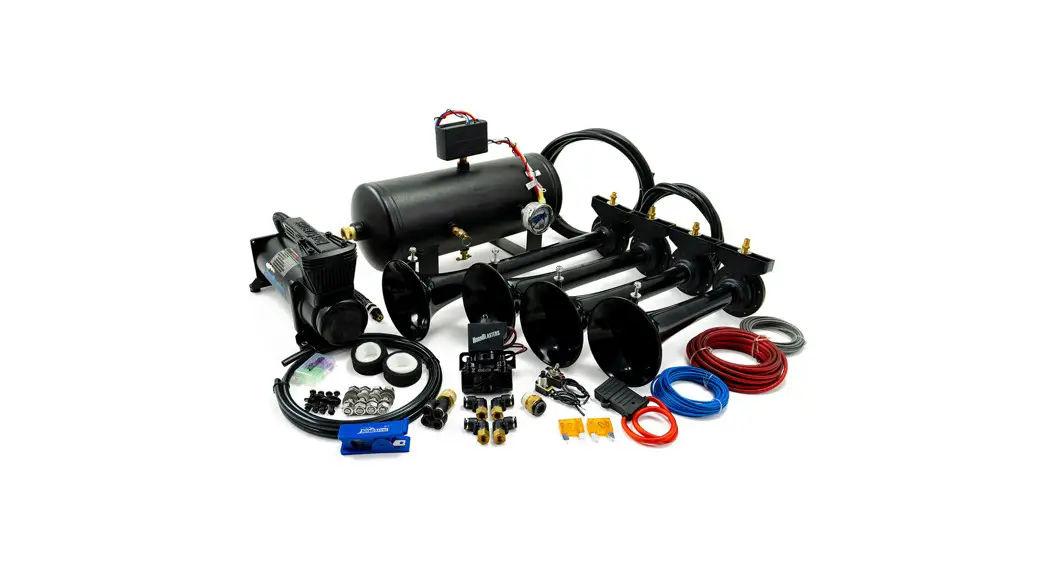
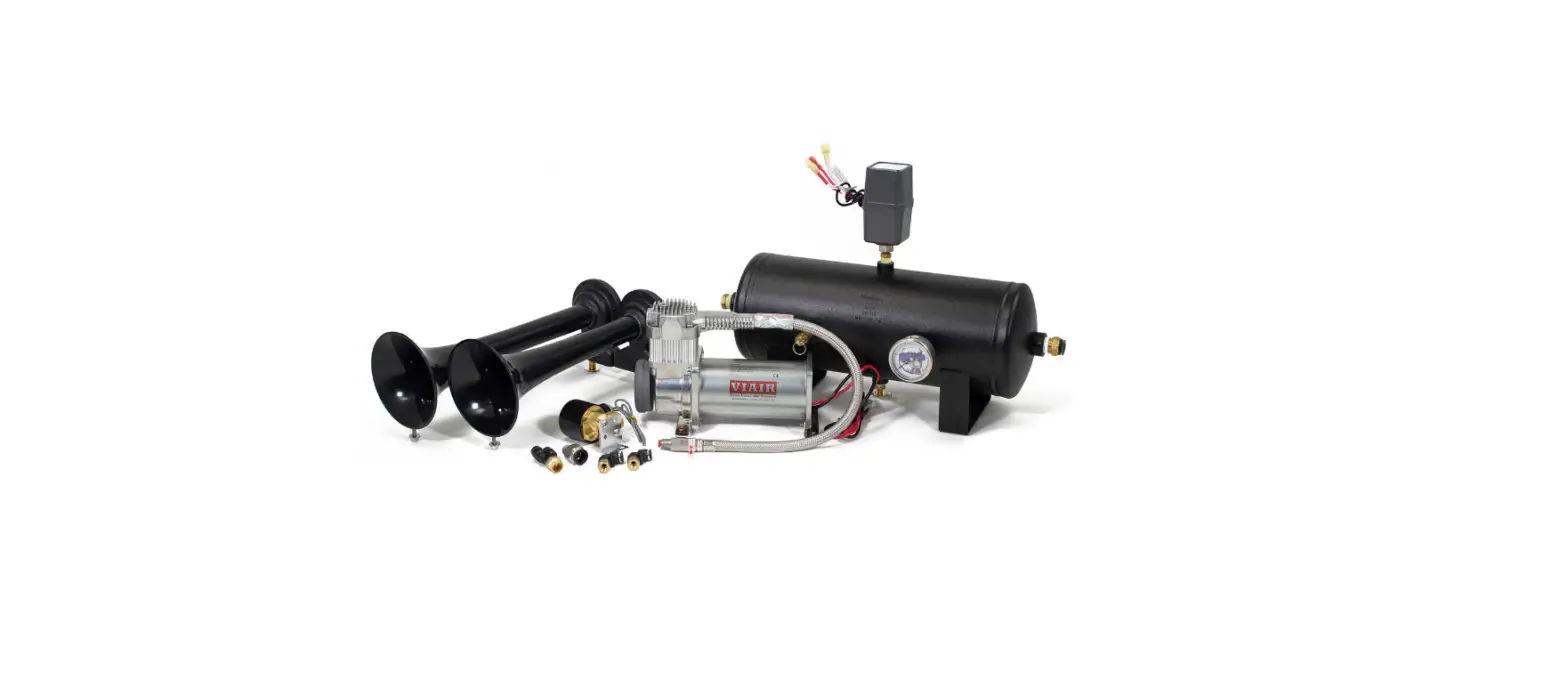
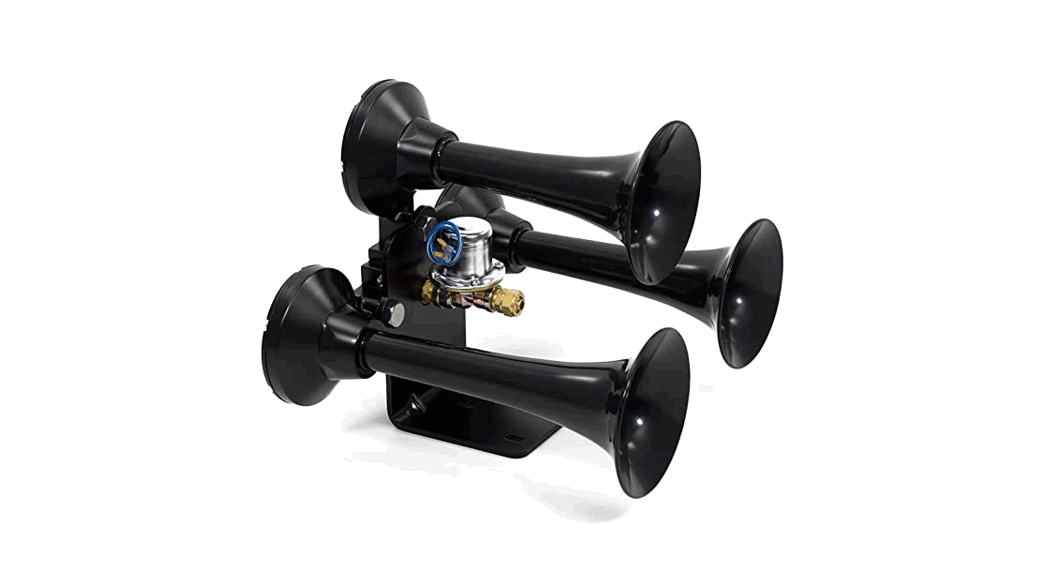
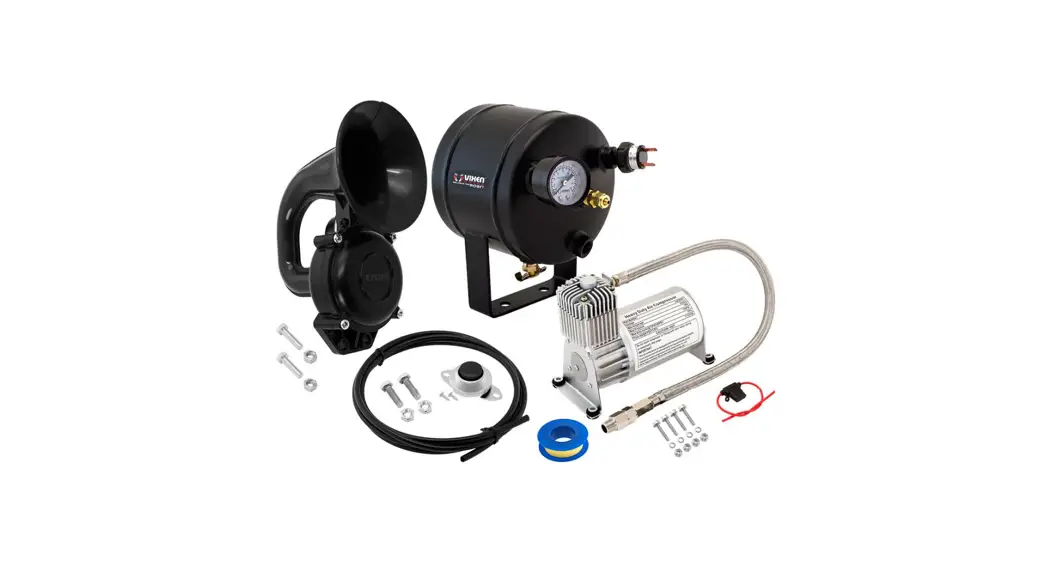
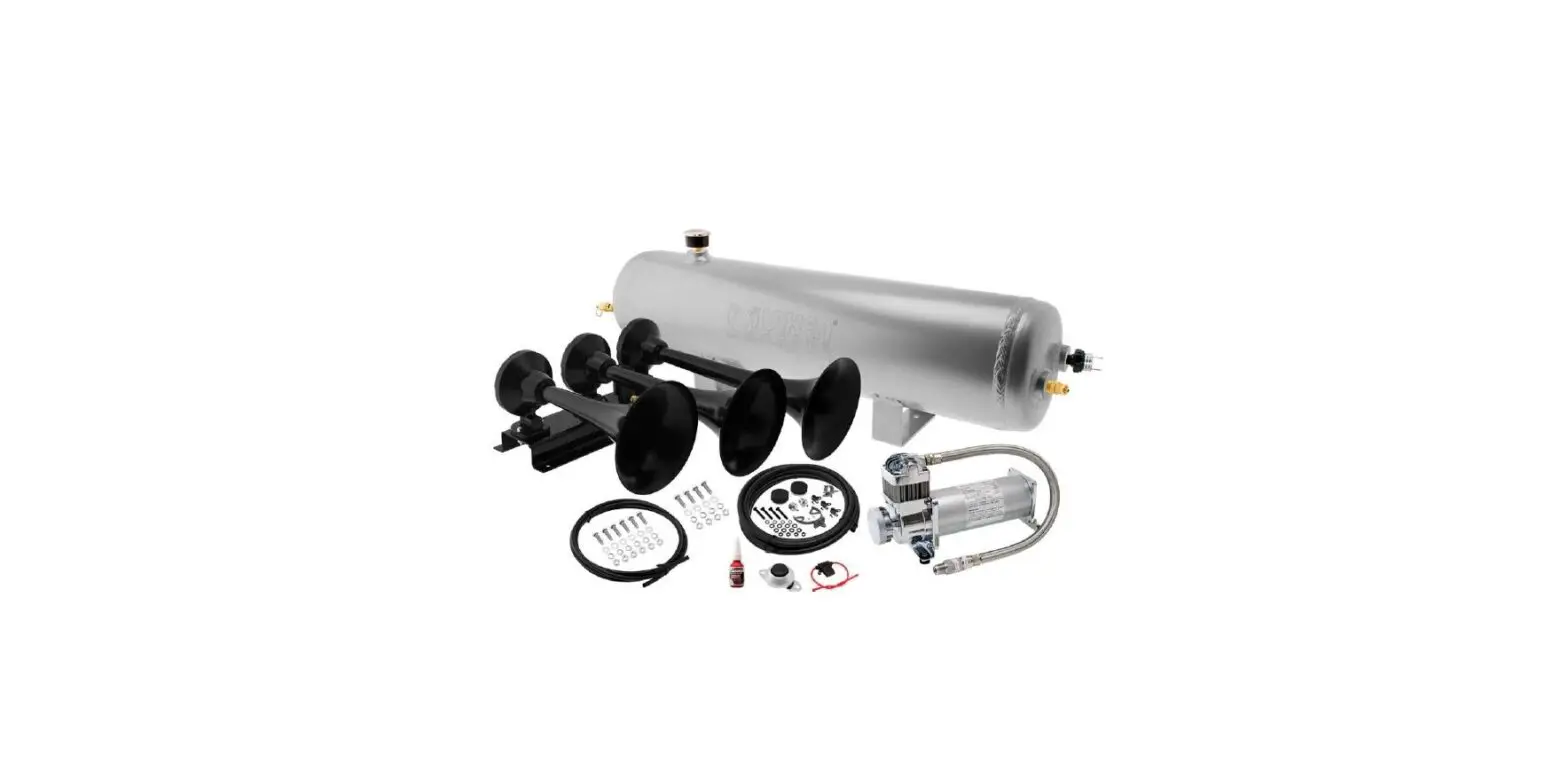
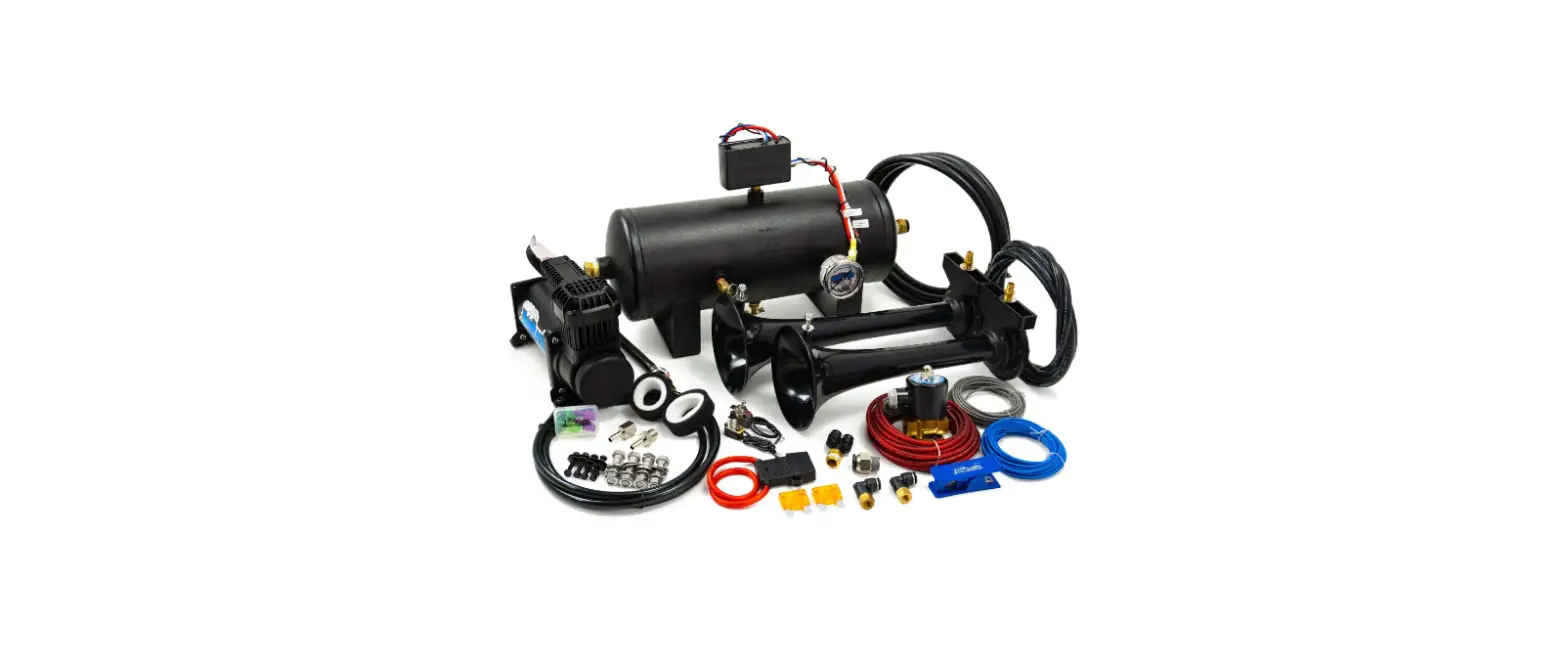
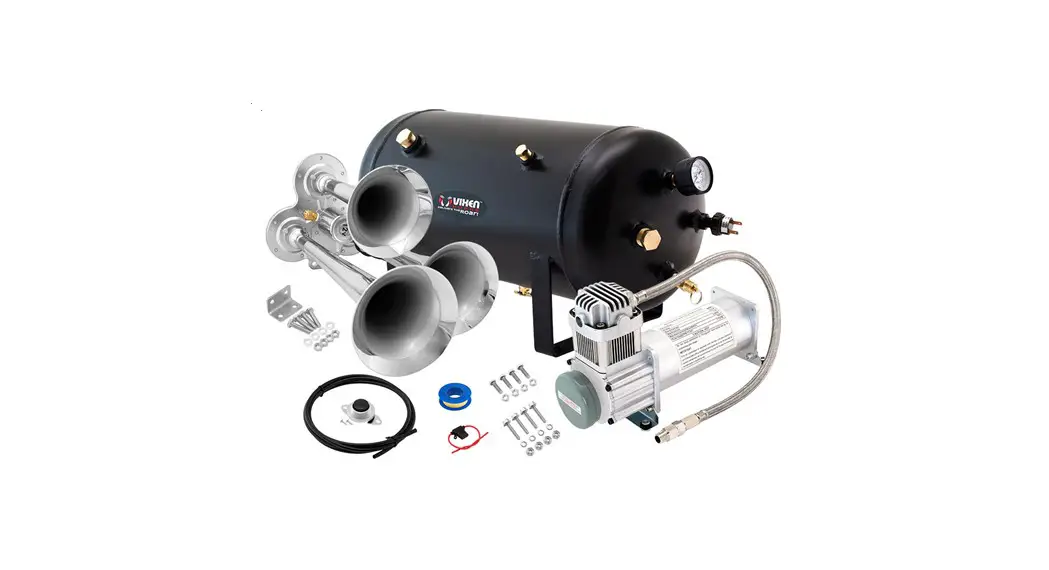
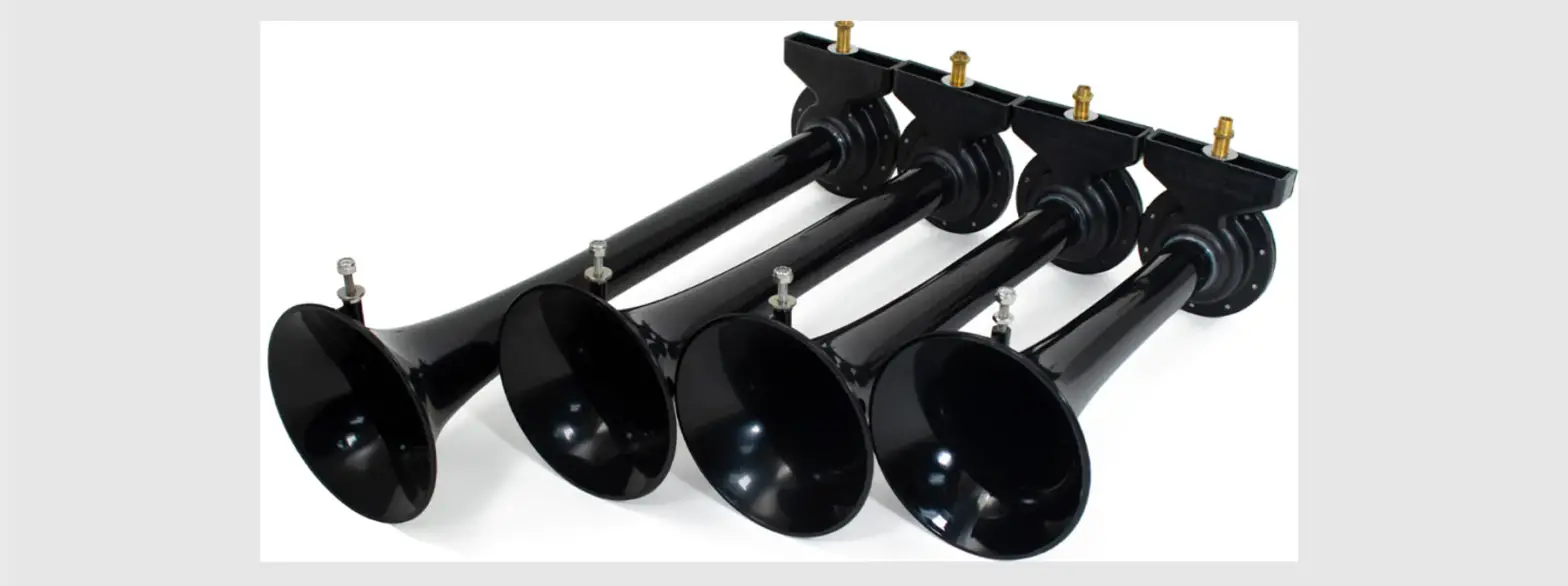
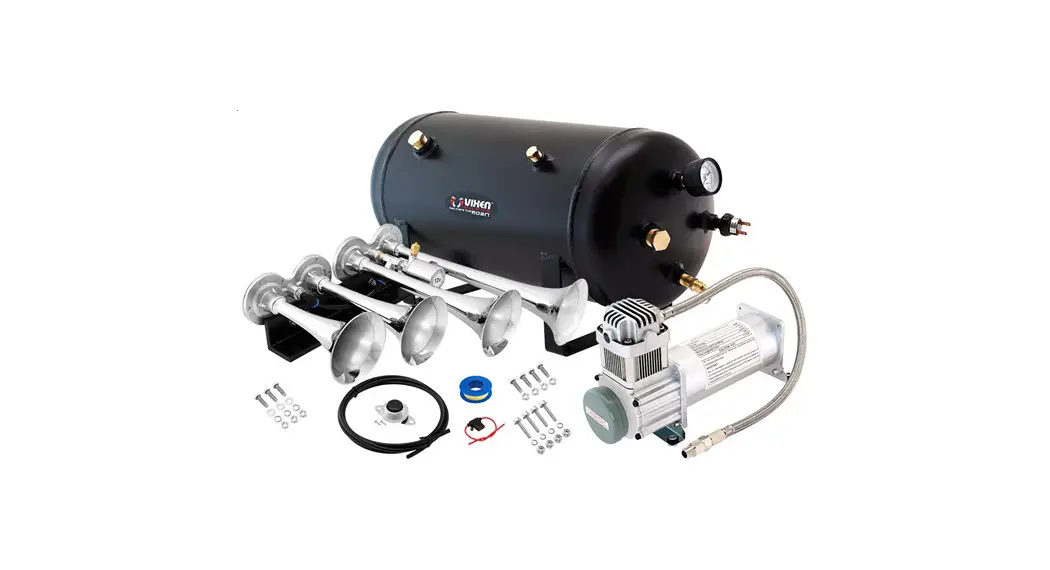
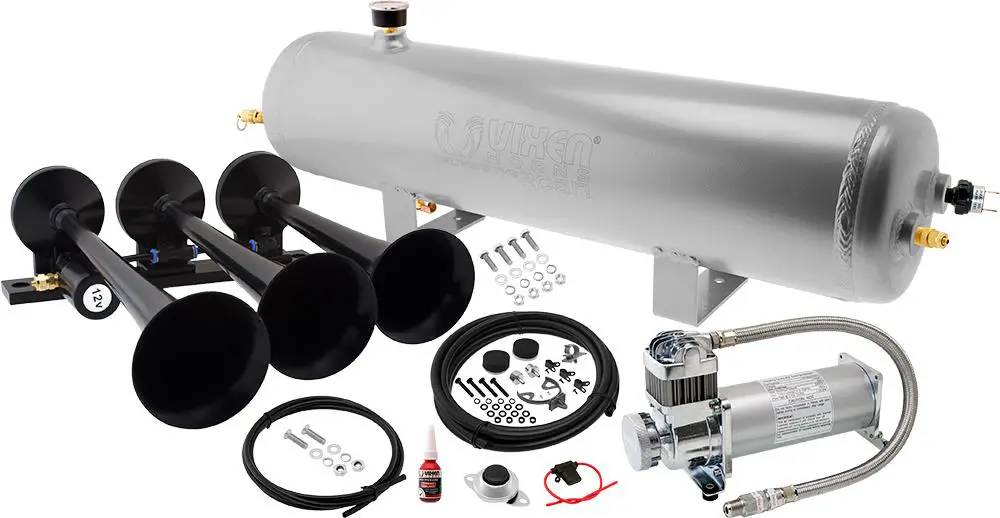
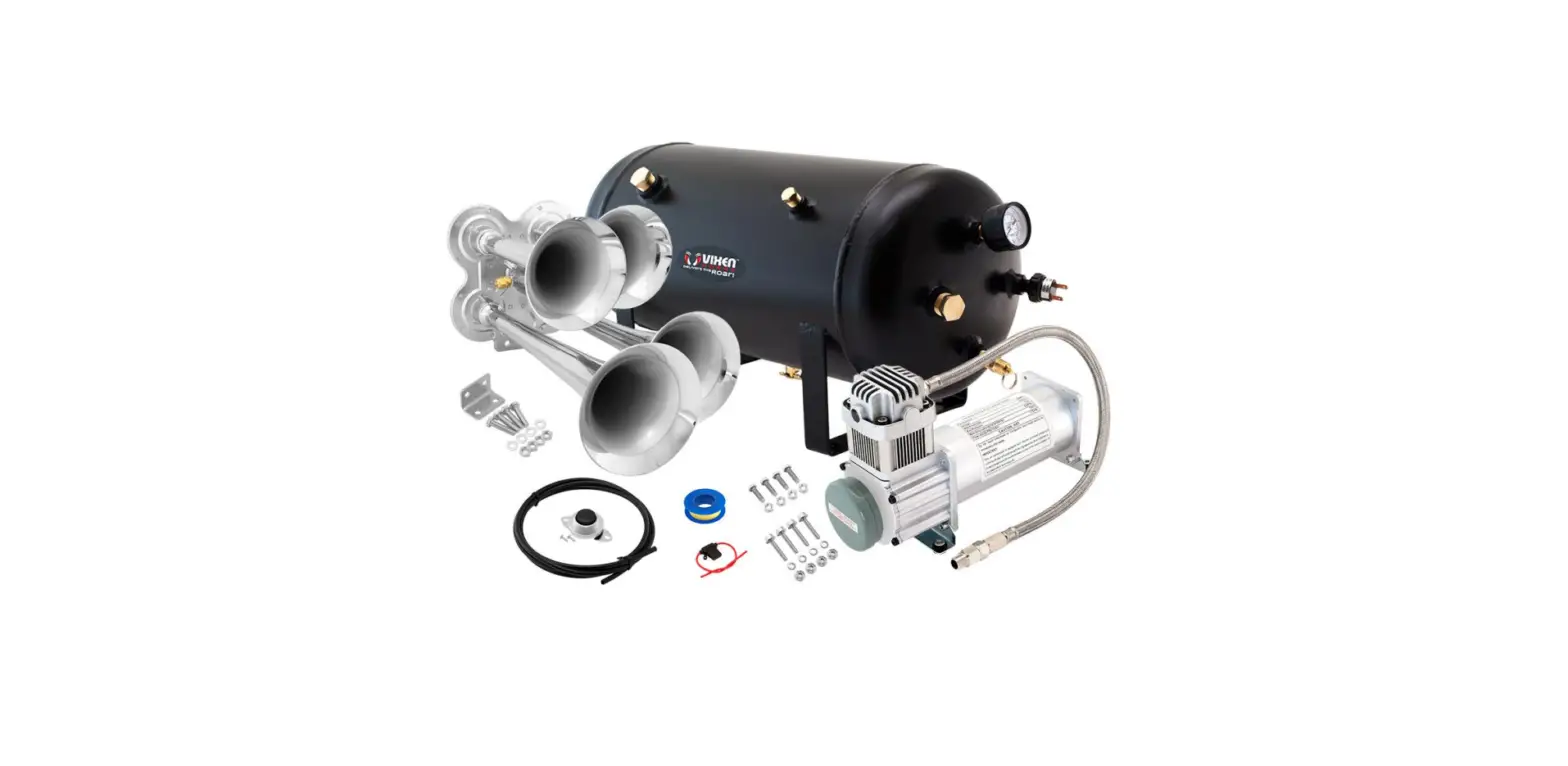
HK-MC3B-F3B-127 Train Horn Kit
Product Information
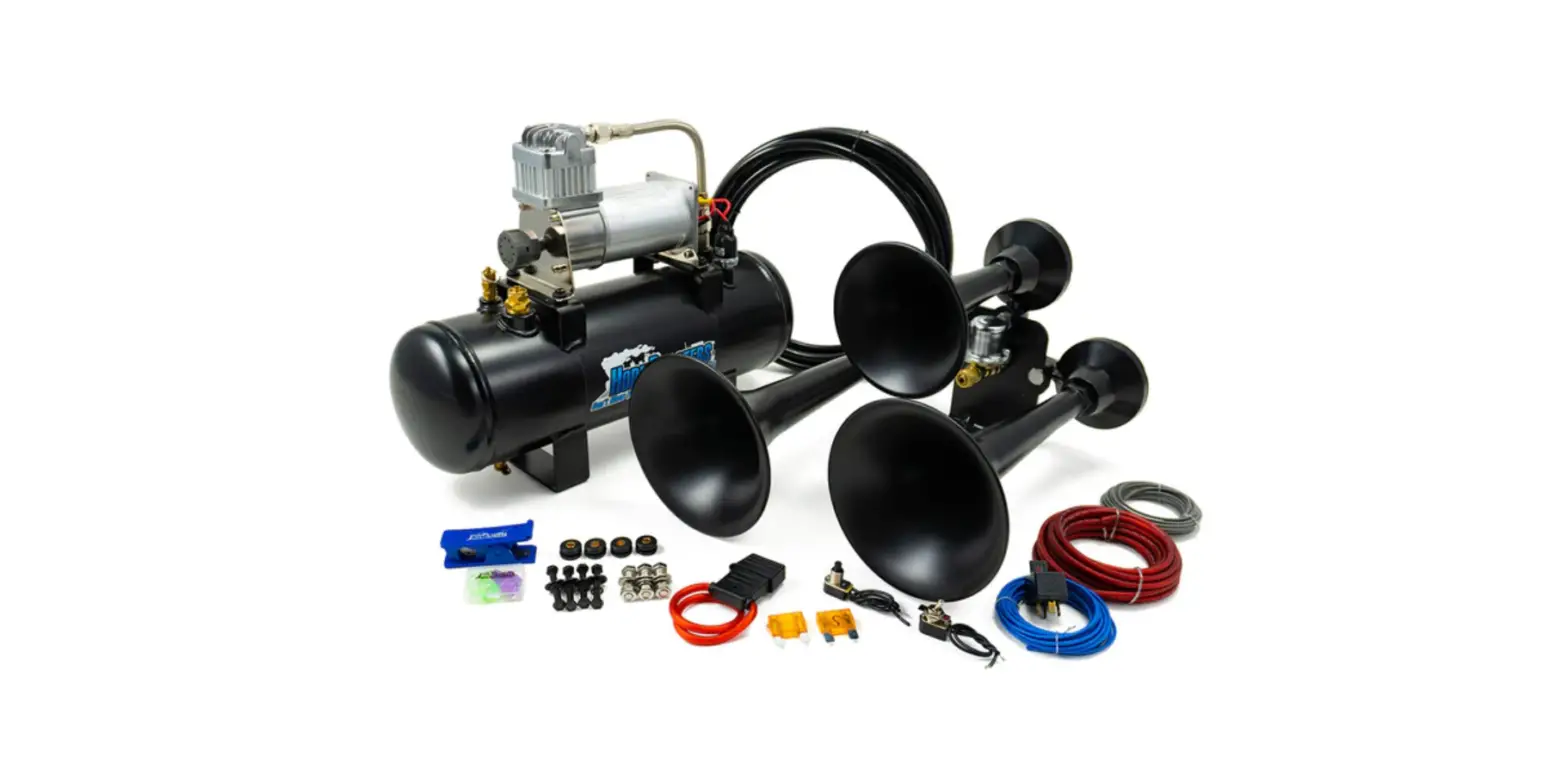
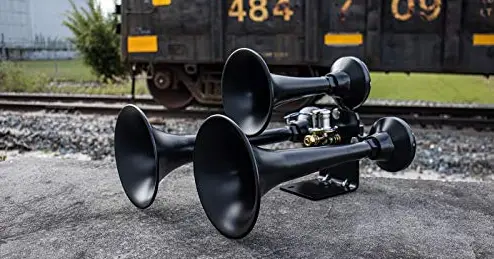
The Mini Outlaw & Flatlaw Train Horn is a powerful and
compact train horn kit designed for vehicles. It includes a 127H
air source, 20 feet of 1/4 air line, a solenoid valve pre-installed
to the horn, the Mini Outlaw or Flatlaw Train Horn, and a universal
wiring kit.
It is important to note that the air source in this kit is not
meant to be mounted outside in the elements. It is not weatherproof
and will not be covered under warranty if mounted outside or
exposed to the elements. The air source must be mounted upright for
proper operation.
Product Usage Instructions
- Before proceeding with the installation, ensure that you read
and follow the instructions provided in the manual. - Regularly change filters and drain the moisture from the tank
to ensure the longevity of your system. - Ensure that the air source is mounted upright and not exposed
to the elements. - Review the kit contents, which include the 127H Air Source, 20
feet of 1/4 air line, a solenoid valve pre-installed to the horn,
the Mini Outlaw or Flatlaw Train Horn, and a universal wiring
kit. - For safety purposes, follow the recommended tools and
compatible add-on kits provided in the manual. - When installing the compressor, ensure it is attached to the
tank and remains upright. Recommended install locations for trucks
include under the hood or on the engine block. - When installing the horns, choose locations that are suitable
and will not cause damage. Regularly honk the horns to prevent
buildup or dust/dirt from affecting the horn assembly. - Refer to the plumbing diagram in the manual for proper air line
installation. Ensure that the air line is cut flush to create a
proper seal and prevent leaks. - To change the air filter, use a flathead screwdriver to pry the
filter housing apart. Remove the old filter element and insert the
new element, aligning the white portion with the plastic tabs.
Replace the cover back over the housing. - It is recommended to change the compressor filter every 2-3
months to prevent dirt and dust from damaging the compressor. - Refer to the provided wiring diagram and instructions for
proper wiring of the air source.
If you have any further questions or need assistance, you can
contact HornBlasters at +1 (813)
783-8058 or email them at [email protected].
Page 1
MINI OUTLAW & FLATLAW TRAIN HORN INSTALLATION MANUAL
127H
WARNING: To ensure the longevity of your system, reading and following these instructions are recommended. Make sure to change filters and to drain the moisture from your tank on a regular basis. BEFORE YOUR PROCEED! THE AIR SOURCE IN THIS KIT IS NOT MEANT TO BE MOUNTED OUTSIDE IN THE ELEMENTS! IT IS NOT WEATHER PROOF AND WILL NOT BE COVERED UNDER WARRANTY IF MOUNTED OUTSIDE OR EXPOSED TO THE ELEMENTS! MUST BE MOUNTED UPRIGHT.
Page 2
HORNBLASTERS MINI OUTLAW / FLATLAW TRAIN HORN 127H KIT CONTENTS
· Air Source Kit (127 / 228H)
· Ear Plugs
· HornBlasters Mini Outlaw Train Horn OR HornBlasters Flatlaw Train Horn
· 17′ 1/2″ Airline
· Air line Cutter · Mounting Hardware · HornBlasters Universal Wiring Kit
1x 127H Air Source
20 Feet 1/4″ Air line
1x Solenoid Valve
(pre-installed to the horn)
1x HornBlasters Mini Outlaw Train Horn
or Flatlaw Train Horn
1x HornBlasters Universal Wiring
Kit
Page 3
Safety Tips and Important Information
IMPORTANT SAFETY INSTRUCTIONS Caution: To prevent the risk of electric shock or electrocution:
· Do not disassemble any electrical components of this horn kit (air compressor, air valve, pressure switch). · Do not attempt repairs or modifications of any component. Please refer to qualified service agencies for all
service and repairs. · Do not operate any component where it can fall or be submerged into water or any kind of liquid. · Do not reach for any component that has fallen or been submerged into water or any kind of liquid. · Use the included components with 12 volt DC systems only. · Do not leave the air system unattended during use.
WARNING: To prevent injury:
· Never allow children to operate the compressor or air horn. Use close supervision when operating this equipment near children or animals. · The air compressor will become very HOT during and immediately after operation. Do not touch any part of the compressor with your bare hands during or immediately after use. · Do not use this product near open flames or explosive materials or where aerosol products are being used.
· Do not operate this product where oxygen is being administered.
· Do not pump anything other than atmospheric air.
· Never use this product while sleepy or drowsy. · Do not use any tools or attachments with the supplied air source unit without first determining maximum air pressure for that tool or attachment.
· Never point any air nozzle or air sprayer toward another person or any part of your body. · The included compressor is equipped with an automatic reset thermal protector and can automatically restart after the thermal protector resets. Always cut off power source when thermal protector becomes activated.
· Use only in well ventilated areas.
· Do not sound the air horn(s) in close proximity to another person’s or your own ear(s).
· Do not fill the included air tank above 150 PSI. Doing so may result in death or serious injury. · Disconnect the battery negative cable before doing anything. Failure to disconnect this terminal can lead to damaged electrical components.
· Use eye protection when operating drills or other power tools during the install.
· Ensure the parking brake is engaged before you get underneath the vehicle.
· Do not wire the system without the fuse holder.
· Do not allow the compressor to run when the vehicle is off.
www.hornblasters.com
Page 4
Recommended Tools + Addons
Recommended Tools
· 1/2″ Wrench · 7/8″ Wrench (4-Way Splitter on Valve) · Wire Cutter / Stripper / Crimp Tool
· 10mm Wrench or Socket (Air Source Mounting) · 12mm Wrench / Socket · Drill (8mm Bit)
Compatible Add-on Kits (available @ www.HornBlasters.com)
Name
Description
Tire Inflation Kit
Adds a quick disconnect to your system which allows you to use air tools with our kit.
Part #
AA-TIK-H
Electric Drain Valve Kit
Replaces the drain cock with a solenoid valve; allows for remote draining of the system
AM-D04K
Digital Air Gauge
2′ Digital Air Pressure Gauge allows you to monitor the tank pressure in the cab
GA-220H
Single Path Air Management Kit
Allows you to inflate load support air bags from our air source kit.
AM-LSK1
Dual Path Air Management Kit
Allows you to inflate both left and right helper bags independently.
Optional Install Items (Not required but will make your install easier) · Add-a-circuit – Great for tapping into a key-power source from your fuse-box.
AM-LSK2
· Self-Tapping Screw – These can be used for ground points on the pressure switch, compressor, and valve.
· Slotted Angle Iron – Can be used to mount the horns without making a plate.
· Cable Ties – Used to keep your air line looking clean and organized.
· Heat Shrink Tubing – Can be used over the terminal connectors to better seal them up against the
elements.
· 1″ Adjustable Wrench – Makes it easier to get the brass fittings into the tank. You can use one wrench for
all the fittings on the system.
· Thread Sealant – Can be used instead of Teflon to seal fittings.
Page 5
Preparing For the Install (continued) Recommended Install Locations for Trucks (Compressor)
· The toolbox is a great location for the compressor. Do not use the toolbox as a grounding point. · Mounting the compressor/tank in the bed (if covered) is a great option. There’s plenty of room available and
mounting the compressor will help it run cooler and save space in your toolbox. · The engine bay is a good spot for the compressor as long as you keep it away from the exhaust manifold and
engine block. The compressor must remain upright and attached to the tank as well.
Recommended Install Locations (Horns)
· You can mount these horns underneath the bed or in the bed itself. · If you face the horns forward when mounted underneath they may pickup some dirt/dust from the road. This
is normal and will not damage the horn. Make sure to honk the horns regularly to keep any buildup or dust/ dirt out of the horn assembly.
Plumbing Diagram
Page 6
Plumbing the air line to the tank and horn
Bad Cut
Good Cut
Ensure each air line is fully seated over the compression fitting before tightening the nut down over it. If the line is not fully seated over the barb, it can slip off the fitting even with the nut in place. Firmly hold the line in place and use a wrench to tighten the compression ferrule down. The line will not seal properly if you don’t hold it down in place while tightening the nut. It will slip off! The horn will sound very weak if the line isn’t seated properly. If the line is too stiff, you can heat it up to make it more malleable. Don’t over-do it on the heat as it will melt at a certain point.
*Take note of the air line to the left. If the line is not cut flush, it will not seal and will create a leak directly out of the tank.
Changing the Air Filter
Use a flathead screwdriver to pry the filter housing apart. You can insert the flat end of the screwdriver into seam, where the arrow is
Remove the old filter element from the housing. Insert the new element into the center so that the white portion of the filter lines up with the plastic tabs. Replace the cover back over the housing, lining the tabs up on the sides of the cover.
The compressor filter must be changed out every 2-3 months, otherwise the compressor will start to pull in dirt/dust and wear prematurely.
Page 7
6511 N 54th St Tampa, FL 33610
+1 (813) 783-8058 Fax: +1 (813) 783-2407
MINI OUTLAW / FLATLAW 127H AIR SOURCE WIRING DIAGRAM
(+)
www.hornblasters.com
Cut fuse holder in half at center point
[email protected]
Page 8
6511 54th St Tampa, FL 33610
+1 (813) 783-8058 Fax: +1 (813) 783-2407
Wiring Instructions
Wiring the Relay
Pin 30: This pin will connect to the battery positive terminal. You MUST use the supplied 10-gauge RED wire for this connection. Use the supplied tan or green terminal to connect the red wire to this pin. Cut the fuse holder wire in half at the center point. Connect one end to the battery positive terminal. Connect the other end to a lead of 10 ga. red power wire that runs back to the relay.
Pin 86: This pin will connect to a key-power source. You are looking to connect this pin to any circuit that is ONLY ON WHEN THE VEHICLE IS ON. This will prevent your kit from running when the vehicle is off. Common key-power sources include the cigarette lighter fuse, sunroof, radio, trailer running lights, daytime running lights, etc. You can use any circuit that is rated for 5A or less. The relay only needs a fraction of an amp to operate.
Pin 85: Route a lead from this pin to the frame of the vehicle as a ground point. You may use the supplied Blue or Grey wire for this connection. You can use a wire brush on the frame or bed coating to ensure a good connection to metal is made.
Pin 87: Take the red lead coming off the compressor/tank combo and connect it directly to this pin.
Your relay is now wired and ready for use. You can use a small lead of wire to connect pins 30 & 86 together to test the relay. If you have this wired correctly, the relay should make a light ‘click’ sound when the two pins are connected. This means the relay is turning on and off properly. When you start the vehicle, it will send power to pin 86 and turn the relay on, which will allow the compressor to run.
Key-Power-Source (Normal Method)
If you’re having trouble locating a fuse that is only hot when the vehicle is on, you can go online to https:// fuse-box.info/. You can use a test light to check whether or not the fuses are hot with the key in the off position. Route the black probe/clip to the battery negative terminal (-) and use the red probe on the metal contacts of the fuse(s) you want to check. If the light comes on, your fuse is hot. If the light does not turn on, start the vehicle and check for current. The light should illuminate now that the vehicle is running.
Using A Toggle Switch Instead of a Key Power Source
If you can’t find a good key power source, you can use a toggle switch instead to manually stop the
compressor from running. To do this, locate the supplied toggle switch that came with your horn kit. Wire
one lead of the toggle switch to +12v power and take the opposite lead of the toggle switch to pin 86 on the
relay. When you flip the switch on, the relay will switch on and allow the compressor run. Wiring your kit
this way means that you MUST turn the switch off with the vehicle, otherwise the compressor could run
overnight and drain your battery.
www.hornblasters.com
Connecting the Train Horns to the Steering Wheel
Page 9
A = 18 Gauge Butt Connector (use to connect two wires together)
B = T-Tap / Scotchlok Connector (use to tap off factory horn wire)
Connecting the Train Horns to a Push Button
Page 10
Maintenance / Tips (Do not throw this away!)
!Once every…
· 2 Weeks o Drain the air tank of moisture! Do not let the water build-up in the tank longer than 2 weeks. The water can find it’s way into your horns and cause them to sound squeaky or not at all. The water can also find it’s way into your pressure switch and cause it to fail.
· Month o Check the air filter element for the compressor. If the element is showing signs of dust/dirt build-up, replace it with a new one.
· 2 Months o Check your air lines and make sure they’re not rubbing against anything. Inspect the horns for damage. o Check your wiring for corrosion (especially in the winter time) If the terminal connectors become oxidized or corroded, the kit could stop working at random in the future.
· 3 Months o Replace the filter if you haven’t already. Inspect the filter if it was recently replaced. o Check the tank for leaks. After being installed on your vehicle for some time, the vibration from daily use can cause a small leak to occur at the fittings or air line connections. Spray down with Windex or soapy water to find the leak point.
· Year o Check your ground connections. If the connection to the frame isn’t that good or comes loose, the compressor or solenoid valve will stop working properly. Use a wire brush to clean these up if needed. o Inspect your mounting hardware for the compressor/tank/horns. Ensure all components are still secured nice and tight.
Drain Cock
Closed Position
Drain Cock
Open Position
Identifying Fittings
The diameter of the thread (X) will indicate what size thread a fitting has. If you’re not sure which fittings are 1/2″, 3/8″, or 1/4″, measure the thread on each fitting and match it up with the values below.
1/2″ NPT
3/8″ NPT
1/4″ NPT
1/8″ NPT
0.84″
0.675″
0.54″
0.405″
www.hornblasters.com
Page 11
Troubleshooting Compressor
· The compressor doesn’t turn on.
o Try connecting the compressor to a 12v battery directly.
Take the red wire to the positive terminal and the black wire to the negative terminal.
Give us a call if the compressor doesn’t run. If it does, go to the next step.
o Double check the wiring for the relay. Test the relay if needed Make sure that pin 86 is connected to a good key-power source and ensure than pin 85 is grounded properly. You can test the relay wiring by connecting a small wire from pin 30 and jumping it over to 86. If the compressor runs when you do this, you need to check your keypower source. It is not giving power to the relay.
o Make sure the fuse isn’t blown If the fuse is blown, this could be due to a short in your wiring. Before you put a new one in, check and ensure your wire is not frayed or exposed anywhere.
· The compressor doesn’t fill the tank
o Make sure the drain cock isn’t open
Refer to page 11. If the drain is open, the tank is not sealed and cannot pressurize.
o Make sure the valve isn’t open or backward If the valve is open, the air from the compressor is escaping through it constantly. If the valve is backward, air will escape through it constantly.
o Check the compressor’s air inlet (only applies if you have a 228H) If the plug from the inlet was not removed, the compressor cannot suck in air. Remove the filter and remove the plug. Make sure to check that you removed the plug from the end of the compressor’s leader hose. If the plug is still present, the compressor will not be able to push air out of the hose.
· The tank loses pressure after a few hours
o Spray each fitting and air line with soapy water or Windex®. The liquid will bubble up anywhere a leak is present. Typically, fittings need to be tightened further or more Teflon tape needs to be applied to the thread. If you have a leak from the air line connections, re-cut the lines flush and re-seat them into the PTC fittings.
www.hornblasters.com
Page 12
Troubleshooting Horns
· The horns won’t honk o Check the air tank for air pressure. If your air gauge reads 0 PSI, refer to the steps on page 12 to remedy the lack of air in the tank. o Check the wiring for the horn solenoid valve. If the valve has a loose ground connection, it will not work properly. Make sure the valve is connected to your activation switch. o Check the power source for the horn activation. Use a test light or voltmeter to check for +12v on the lead coming from your stock horn wire or power source. Make sure power is coming into and out of the activation switch/button.
· The horns don’t sound right o If your horns start to squeak or sound high-pitched, drain the tank. Moisture buildup in the tank is finding it’s way from the tank into your horns. This causes them to squeak. Drain the tank of moisture. o Check and ensure the end of each bell(s) isn’t obstructed or blocked. The horns will sound off at a different pitch when the opening of the bell is blocked.
o Clean out the horns with soapy water. Remove the back-cap from each horn with a phillips head
screwdriver. Clean the diaphragm disc and chamber.
· The horn honks on it’s own as soon as it is wired up o This is a tricky problem to fix and can be confusing to most. On some vehicles, the stock horn receives a
constant feed of power from the battery. When the wheel is pressed, a switch inside the steering wheel
creates the ground for the horn circuit and the horn honks. When you wire your OEM horn wire to our
valve, the valve ground completes the circuit and causes the constant honk. We can fix this problem by following these steps: 1. Disconnect the valve ground from the frame. 2. Splice from the OEM horn NEGATIVE lead and route this to the toggle switch. 3. Connect the opposite lead of the toggle to the black wire on the valve.
This makes it so that the valve is actuated from the negative side of the OEM wiring. If you have trouble with this, give our team a call @ (877)-209-8179.
o Make sure the valve isn’t connected to a constant power source. If the valve is receiving power constantly, it will stay open.
· It sounds like the horns are going off at different times o Check the length’s of each air line from the 4-way splitter to each bell. If these lines are not equal length, the horns will sound off at different times. This is not ideal. Check and ensure each air line is secure in the elbow fittings. If one line is loose or disconnected, the other horns will sound muffled due to the loss of air pressure. Can’t find your issue listed above? Give our team a call @ (877)-209-8179 or shoot us an email to [email protected]
www.hornblasters.com
Page 13
 All automotive fuse box diagrams in one place | Fuse Box Diagrams
 HornBlasters - Don't Blow Your Temper, Blow Your Horns!