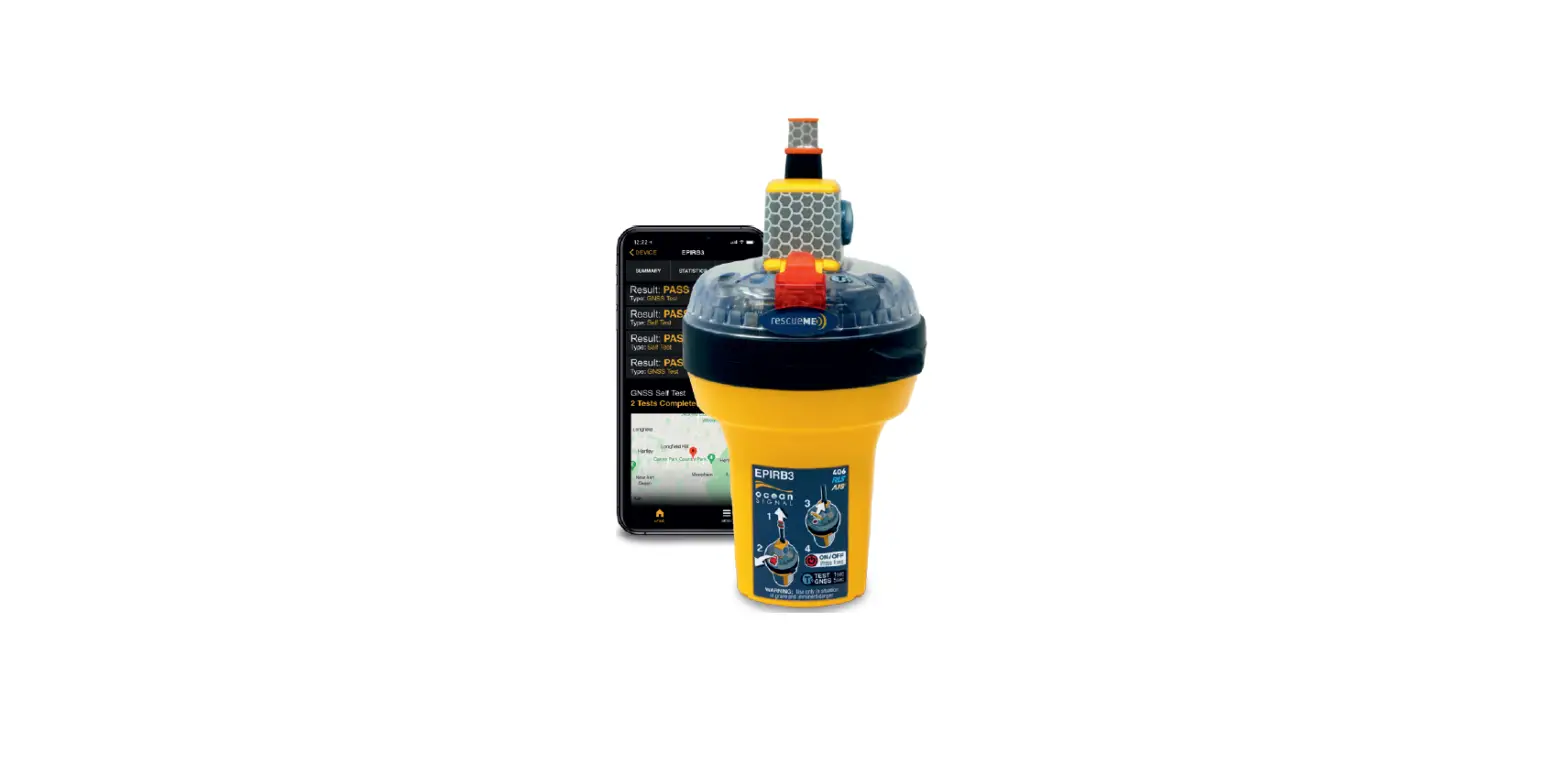
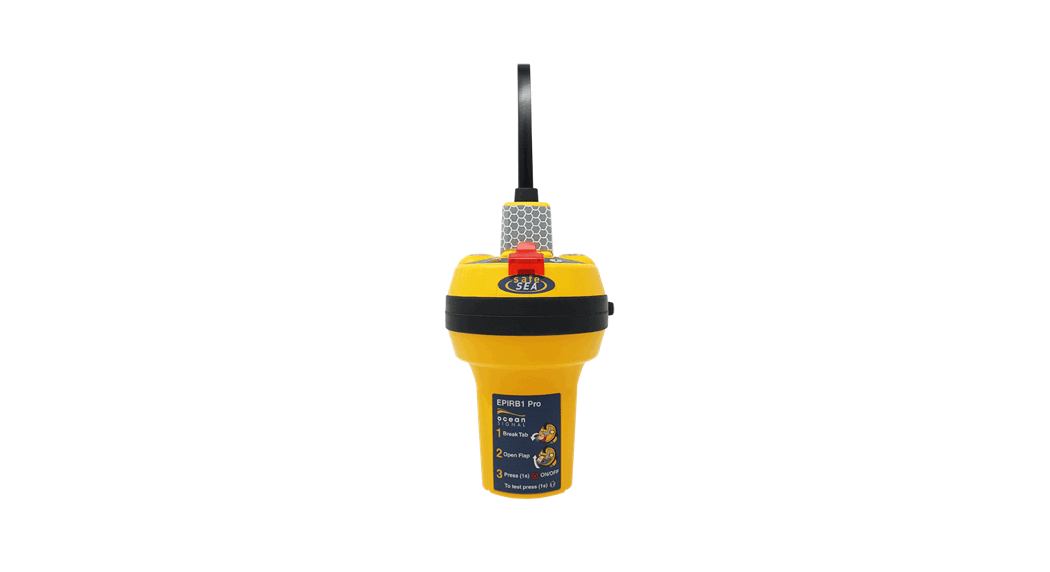
EPIRB3 Pro 406 MHz Global Rescue Beacon
Product Information
Product Name: EPIRB3 Pro
Product Type: Category 1 406MHz EPIRB (With AIS and RLS)
Manufacturer: Oceansignal
Product Website: oceansignal.com/products/epirb3-pro
Contact Tel: [Contact Tel]
Email: [Email]
About Your AIS EPIRB
1.1 COSPAS/SARSAT System
The Cospas-Sarsat System is composed of two types of
satellites.
1.2 Return Link Service
1.3 AIS System
AIS systems operate on VHF radio bands and are fitted to all
commercial shipping and an increasing number of recreational
vessels globally. When activated, an AIS Man Over Board device will
activate an alarm on all AIS equipped vessels within VHF range,
alerting them to the fact that a person is in the water and needing
assistance. Emergency service craft are fitted with AIS receivers,
allowing them to pinpoint a casualty in the water more precisely
than any other system.
Product Specifications
- 406MHz Transmitter:
- Transmit Power (EIRP): [Transmit Power]
- Frequency Modulation Encoding Rate: [Encoding Rate]
- AIS Transmitter:
- Transmit Power (EIRP): [Transmit Power]
- Frequency: [Frequency]
- Baud Rate: [Baud Rate]
- Synchronisation Messages: [Messages]
- Repetition Interval: [Repetition Interval]
- 121.5MHz Transmitter:
- Transmit Power (PERP): [Transmit Power]
- Frequency Modulation Duty Cycle: [Duty Cycle]
- Modulation Factor: [Modulation Factor]
- Frequency Stability: [Frequency Stability]
- Duty Cycle: [Duty Cycle]
- Strobe and Night Vision Lights:
- Light Type: [Light Type]
- Light Colour: [Light Colour]
- Average Intensity Visible: [Average Intensity Visible]
- Average Intensity Night Vision Light: [Average Intensity Night
Vision Light] - Flash Rate: [Flash Rate]
- Battery:
- Type: [Battery Type]
- Operating Time: [Operating Time]
- Battery Replacement Period: [Battery Replacement Period]
- GNSS Receiver:
- Satellite Channels: [Satellite Channels]
- Sensitivity Cold Start / Re-acquisition: [Sensitivity Cold
Start / Re-acquisition] - GNSS Antenna: [GNSS Antenna]
- General:
- Dimensions of EPIRB (Inc. antenna): [Dimensions of EPIRB]
- Weight (EPIRB Only): [Weight]
- Dimensions of Automatic Release Housing: [Dimensions of
Automatic Release Housing]
Product Usage Instructions
Beacon Registration: It is the owner’s
responsibility to register this beacon with the appropriate
National Authority before operation. Refer to the documentation
provided within the packaging for information on registration with
the relevant body.
In Case of Emergency:
- Pull the pin
- Release the catch
- Turn the knob
- Remove the cover
- Release the EPIRB
- Break the tab
- Lift the flap
- Press the button
Note: Remove the rubber lanyard cover and tie
the lanyard to the life raft or your person to prevent loss. DO NOT
tie to a vessel that is in danger of sinking.
Activation and Deactivation:
Once removed from the bracket, the EPIRB3 will automatically
activate when placed in the water. To deactivate, remove it from
the water.
EPIRB3 Pro
DOWNLOAD THE FULL USER MANUAL oceansignal.com/products/epirb3-pro
GET THE MOBILE APP. TO SEE YOUR
BEACON’S TEST INFORMATION
iOS
Android
Category 1
406MHz EPIRB
(With AIS and RLS)
CONTACT Tel.
Email
BEACON REGISTRATION
! It is the owner’s responsibility to register this beacon with the appropriate National Authority before operation.
Documentation is provided within the packaging with information regarding registration with the relevant body to comply with the required configuration of the beacon. ATTACH YOUR BEACON DETAILS HERE
1. ABOUT YOUR AIS EPIRB
1.1 COSPAS/SARSAT System
The basic Cospas-Sarsat concept is illustrated in the adjacent figure. The System is composed of:
· distress radio beacons (ELTs for aviation use, EPIRBs for maritime use, and PLBs for personal use) which transmit signals during distress situations
· instruments on board satellites in geostationary and low-altitude Earth orbits which detect the signals transmitted by distress radio beacons
· ground receiving stations, referred to as Local Users Terminals (LUTs), which receive and process the satellite downlink signal to generate distress alerts
· Mission Control Centers (MCCs) which receive alerts produced by LUTs and forward them to Rescue Coordination Centers (RCCs), Search and Rescue Points Of Contacts (SPOCs) or other MCCs
The Cospas-Sarsat System includes two types of satellites:
· satellites in low-altitude Earth orbit (LEO) which form the LEOSAR System · satellites in geostationary Earth orbit (GEO) which form the GEOSAR System The future Cospas-Sarsat System will include a new type of satellite in the medium-altitude Earth orbit (MEO) which will form the MEOSAR System.
1.2 Return Link Service
The Galileo Return Link Service (RLS) is a free-of-charge global service available to Cospas-Sarsat RLS compatible beacons. The new functionality, currently offered uniquely by Galileo, enables a communication link that relays Return Link Messages (RLM) back to the originating beacon through the Galileo Navigation Signal in Space. The RLS feature is an indication on the EPIRB3 Pro that confirms to the User that the distress signal from the EPIRB3 Pro has been localised by the Cospas-Sarsat system and is being sent to the SAR authorities. It does NOT mean that a search and rescue mission has been launched, but only confirms that the distress alert has been received by the Cospas-Sarsat system and is being routed to the appropriate SAR agencies. The RLS aims to send an acknowledgment to the beacon within 30 minutes following activation (the response may not be received by the beacon for significantly longer). RLS is an optional function and may not be permitted in all countries. The full RLS specification can be found here: https://gsc-europa.eu/sites/default/files/sites/all/files/Galileo-SAR-SDD.pdf
1.3 AIS System
AIS systems operate on VHF radio bands and transceivers are fitted to all commercial shipping and an ever growing number of recreational vessels globally. Shortly after activation an AIS Man Over Board device will activate an alarm on all AIS equipped vessels within VHF range alerting them to the fact that a person is in the water needing assistance. Often it is a vessel in the close vicinity of an incident that is able to react and effect a rescue quicker than the emergency services.
Emergency service craft are fitted with AIS receivers allowing them to pinpoint a casualty in the water more precisely than any other system.
OWNER DETAILS Name
Vessel
12W 406.031 MHz ±1KHz Phase ±1.1 Radians (16K0G1D)
Biphase L 400 bps
1Watt±3dB 161.975/162.025MHz ±500Hz
9600baud UTC
Message 1 (Position), Message 14 (Status) 8 messages/minute
Message 14 sent twice every 4 minutes
50mW±3dB 121.5 MHz
>35% 0.85 to1.00
±50ppm >98%
High Intensity LED & Infrared (IR) White and IR >1 candela 15mW/sr
24 per minute (nom.)
Lithium Iron Disulphide (LiFeS2) >48Hours @ -20°C 10 years
72 acquisition -167dBm
-148dBm / -160dBm Microstrip Patch
410mm x 90mm x 101mm (16.1 x 3.5 x 3.9 in.) 422grams (0.92lbs)
237mm x 191mm x 121mm (9.3″ x 7.5″ x 4.8″)
1,252grams (2.76lbs) Portable
Class 2 -20C to +55C Class 2 -30C to +70C 10m depth for 1 hour
4m maximum
14/11/2022
IN CASE OF EMERGENCY
USE ONLY IN SITUATIONS OF GRAVE AND IMMINENT DANGER MANUAL ACTIVATION
1 Pull the pin
2 Release the catch
3 Turn the knob
4 Remove the cover
5 Release the EPIRB
6 Break the tab
7 Lift the flap
8 Press the button
NOTE: NOTE:
Lanyard Cover Remove the rubber lanyard cover and tie the lanyard to the life raft or your person to prevent loss. DO NOT tie to a vessel in that is in danger of sinking.
Once removed from the bracket the EPIRB3 will automatically activate when placed in the water. To deactivate remove from the water.
Specifications
406MHz Transmitter Transmit Power (EIRP) Frequency Modulation Encoding Rate
AIS Transmitter Transmit Power (EIRP) Frequency Baud rate Synchronisation Messages Repetition interval
121.5MHz Transmitter Transmit Power (PERP) Frequency Modulation Duty Cycle Modulation Factor Frequency Stability Duty Cycle
Strobe and Night Vision Lights Light Type Light Colour Average Intensity Visible Average Intensity Night Vision Light Flash Rate
Battery Type Operating Time Battery Replacement Period
GNSS Receiver Satellite Channels Sensitivity Cold Start / Re-acquisition GNSS Antenna
General Dimensions of EPIRB (Inc. antenna)
Weight (EPIRB Only) Dimensions of Automatic Release Housing
Weight (Inc. EPIRB) IEC60945 Category Operating Temperature Storage Temperature Waterproof (EPIRB) Auto Release Depth
912S-03970 v01.11
7 .
2. OPERATION
! WARNING: Use only in situations of grave and imminent danger. Deliberate misuse may result in a severe penalty.
Ensure that your beacon is always fitted with an unused battery that is within the marked expiry date. Failure to do so may result in reduced operating time when used in a real emergency. Please observe the recommendations on testing in section 9 of the User Manual.
!
! ! !
2.1
· · · ·
Category 1 beacons are designed to be automatically deployed from the Automatic Release Housing and will automatically be activated on contact with the water. Category 1 beacons MUST be removed from the housing before they can be manually activated.
To prevent loss secure the beacon to your person or life raft using the attached lanyard.
Never secure the lanyard to the vessel, this will cause the EPIRB to sink with the vessel.
When active the beacon is designed to operate while floating in the water. For best operation do not take the beacon into a life raft or obstruct the upper case.
Optical Indications on activation
The LED will illuminate green (blue if RLS is enabled) for 1 second.
The strobe light
will start flashing.
Within 1 minute of activation, the indicator LED will flash a quick burst of 5 indicating 406MHz transmission*. AIS transmission will be indicated by the LED flashing 8 times at 2 second intervals (green
if a GNSS fix has been acquired or red if there is no fix). This will not happen until after the first 406MHz transmission,
2.2 Deactivation
To deactivate your beacon after use or if it is accidentally activated, press and hold the ON/OFF Key until the LED flashes red twice, then release.
2.3 Automatic Activation (Ensure the antenna is released)
The beacon requires removal from the Auto Release Housing to allow automatic activation. As the beacon is released from the bracket the water contacts are enabled. Place the EPIRB3 in the water to activate. Only manual activation is possible while the EPIRB remains in the Auto Release Housing.
For full installation details see the User Manual: www.oceansignal.com/products/epirb3-pro
* The first 406MHz transmission is made between 48 and 52 seconds after activation.
2.4 LED Indications with RLS Enabled
LED
(x1) (x3) (x5) (x5) (x8) (x8) (x1) (x1) (x1)
When
Every 5 s Once At transmit At transmit At transmit* At transmit* Every 2.5 s** Every 2.5 s** Every 2.5 s
Transmit
406MHz 406MHz AIS AIS 121MHz 121MHz
GNSS
Searching Fix acquired No Fix Fix acquired No Fix Fix acquired
RLS
RLS Request sent RLS Request sent
RLS Reply not received RLS Reply received
5. TESTING
Routine testing of your beacon once a month is highly recommended to ensure it is in good working order. Follow the guidance notes below on the frequency that tests should be carried out. Remember that each test will reduce the battery capacity slightly and reduce the operation time of your beacon during an emergency.
5.1 Functional test
To test your beacon is functioning correctly, press and hold the TEST key for 1 to 2 seconds. The
LED will illuminate red to indicate the key has been pressed, then start flashing. Release the
TEST Key now. After a short pause the strobe
will flash and the indicator LED will produce a
flash sequence.
A passed test flash sequence indicates the total number of hours that the battery has already been in use, up to the time that the test was initiated.
5.1.1 LED Indications with RLS Enabled
No. of Flashes
Functional Test Pass
Fail
1
0 to 1hr 59min
121.5MHz homer
2
2hrs to 3hrs 59min
406MHz power
3
4hrs to 5hrs 59min
AIS signal
4
6hrs to 7hrs 59min
AIS Power
5
8hrs to 9hrs 59min
Battery failure
6
10hrs +
No GNSS
5.1.2 LED Indications for units configured with non-RLS Protocol
No. of Flashes
Functional Test Pass
Fail
1
0 to 1hr 59min
121.5MHz homer
2
2hrs to 3hrs 59min
406MHz power
3
4hrs to 5hrs 59min
AIS signal
4
6hrs to 7hrs 59min
AIS Power
5
8hrs to 9hrs 59min
Battery failure
6
10hrs +
No GNSS
! Because this test transmits a short burst on the aircraft distress frequency of 121.5MHz, please only carry out this test in the first 5 minutes of each hour.
! The battery must be replaced either prior to the expiry date shown on the rear label or after the EPIRB3 has been activated.
! If, during a self test, the LED flashes magenta or amber the EPIRB3 Pro may not have sufficient energy to operate for the specified 48-hour period. Battery replacement is recommended.
NOTE: More information regarding test results is available using the Mobile App.
2.5 LED Indications for units configured with non-RLS Protocol
LED
When
Transmit GNSS
(x1)
Every 5 s
Searching
(x3)
Once
Fix acquired
(x5)
At transmit
406MHz
No Fix
(x5)
At transmit
406MHz
Fix acquired
(x8)
At transmit*
AIS
No Fix
(x8)
At transmit*
AIS
Fix acquired
(x1)
Every 2.5 s**
121MHz
(x1)
Every 2.5 s
*
The AIS transmissions will show as 8 flashes (1 every 2 seconds) as a sequence repeated
once every minute
**
The 121MHz Homer will not transmit until after the second 406MHz transmission.
3. HRU REPLACEMENT
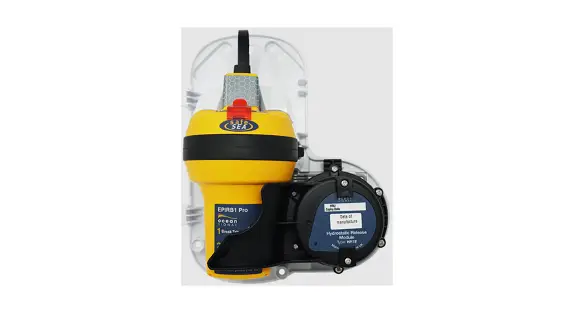
The EPIRB3 Pro is mounted in an Auto Release Housing, this contains a HR1E Hydrostatic Release Unit (HRU). The HRU unit must be replaced two years after installation – the expiry date is marked on the HRU and on the front of the housing.
If this date has been reached then the HRU must be replaced with an Ocean Signal HR1E, failure to do so may result in the HRU not operating correctly during an emergency situation.
See the User Manual for further information regarding the HRU replacement procedure.
NOTE:
The expiry date should be two years from the date of installation on to your vessel, but no more than three years from the date of manufacture provided.
Note the HRU Expiry Date here:
3. INSPECTION
During the monthly EPIRB self test it is advised that the following inspection is performed.
· Inspect the EPIRB for obvious signs of damage including the state of the antenna. Any creases in the antenna may cause the operation of the EPIRB to be impaired.
· Confirm that the EPIRB is securely mounted on the bracket or in the Auto Release Housing. · Inspect the lanyard and ensure it is not attached to any structures. · Confirm the battery is within the specified expiry date. · Confirm the HRU is within the specified expiry date (Two years after the installation date). · Clean the EPIRB and mounting. It is recommended that the EPIRB is cleaned only using a
damp cloth.
There are no user serviceable parts inside the EPIRB3 Pro.
! DO NOT OPEN THE EPIRB3 Pro, DOING SO WILL INVALIDATE THE WARRANTY AND MAY CAUSE FALSE ALERTS
5.2 GNSS Test
! This test should only be performed where the EPIRB3 Pro3 has a clear and unobstructed view of the sky. This is required to allow the GNSS receiver to acquire a signal from sufficient satellites to allow it to determine a position. Ensure the area marked “GNSS Antenna” is not obstructed.
It is recommended that a GNSS test is carried out at least once every six months to ensure correct operation of the EPIRB3 Pro.
Press and hold the TEST key for 5 seconds. The LED will illuminate red to indicate the key has been pressed, then start flashing. Shortly after, the LED will cease flashing and become a steady red light. Release the TEST key when the LED is steady red.
During the GNSS test the LED will repeat a long red flash followed by a short green either a position fix is obtained or the GNSS test fails.
flash until
A successful test will be indicated by a number of green LED flashes and an unsuccessful test will be indicated by a number of red LED flashes. The number of flashes indicates the number of GNSS tests remaining (e.g. 7 flashes = 7 tests remaining).
The test result flashes will be repeated after 2 seconds.
If there are 10 or more tests remaining then the LED will flash 10 times only (repeated).
The EPIRB3 Pro has the capacity to carry out 60 GNSS tests within the lifetime of the battery.
If there are no tests remaining immediately after the current test, the LED will flash green or red rapidly for three seconds (not repeated) depending on whether the GNSS test was successful or
not, respectively.
When there are no tests remaining, the LED will flash red (not repeated).
rapidly for three seconds on key release
The test can be ended at any time by holding the TEST key for 1 to 2 seconds.
For further information regarding Self Test and Self Test history use the Ocean Signal App to connect to your EPIRB3 Pro using Near Field Communication (NFC).
6.
Approvals
In addition to Cospas Sarsat Type Acceptance, the EPIRB3 complies with the following National Approvals:
6.1
European Union
Complies with the requirements of the EU Marine Equipment Directive (MED)
6.2
UK
Complies with MSN 1874 as amended
6.3
USA
Complies with FCC 47 CFR Part 80 and US Coast Guard requirements
6.4
Canada
Compliance with ISED RSS GEN and RSS182
6.5
Australia/New Zealand
Complies with AZ/NZS 4280.1-2017
See “www.oceansignal.com/approvals-documents” for documentation.
 EPIRB3 Pro - Ocean Signal
 Approvals Documents - Ocean Signal